
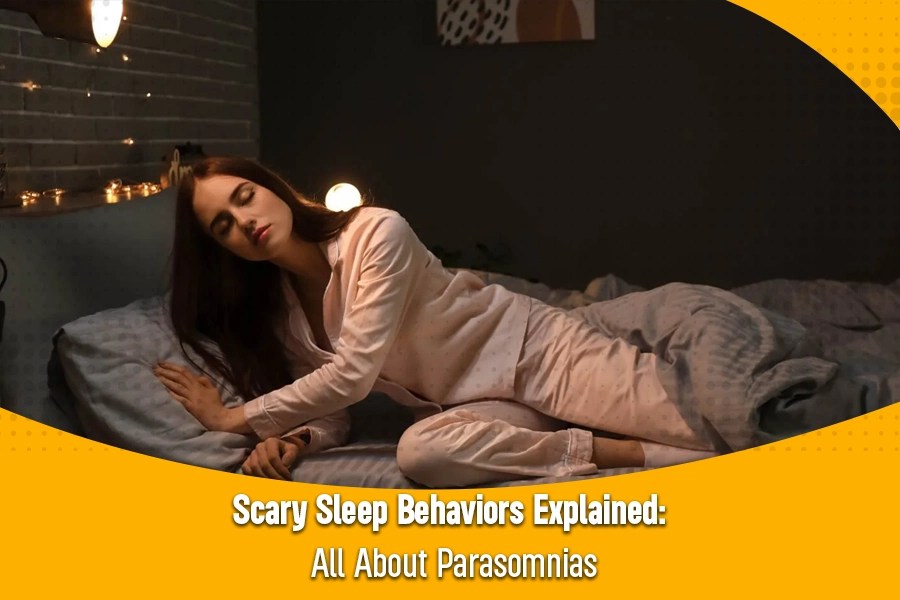
Your partner shakes you awake at 2 AM. You’ve been sitting up in bed having a full conversation with someone who isn’t there. Or maybe you woke up in your kitchen with no memory of walking there. Or your roommate mentioned you were screaming and throwing punches at nothing last Tuesday night.
These aren’t ghost stories. They’re parasomnias, and they’re significantly more common than most people realize. Somewhere between the medical textbook definition and the horror movie version lies the actual reality of what these sleep disruption events involve, why they happen, and what you can realistically do about them.
What Parasomnias Actually Are
The term parasomnia covers a broad category of unusual behaviors, movements, emotions, perceptions, and dreams that occur during sleep or during the transitions between sleep and wakefulness. The word itself comes from the Greek “para” meaning alongside, and “somnus” meaning sleep. Behaviors happening alongside sleep rather than during normal wakefulness.
What distinguishes parasomnias from simply having strange dreams is that they involve actual physical behavior or physiological events during sleep states. Dreaming is passive. Parasomnias are active. Your body is doing something while your conscious mind is offline, which is exactly what makes them unsettling to witness and sometimes dangerous to experience.
Not all parasomnias are created equal. Some are completely benign and often outgrown. Others are serious medical events that carry real safety risks or indicate underlying neurological problems requiring investigation. The difference between these categories matters considerably for how you respond to them.
NREM Parasomnias: When the Brain Gets Confused Between Sleep and Waking
Non-REM sleep parasomnias emerge from the deeper slow-wave stages of sleep, specifically stages N2 and N3. During these stages your brain enters a state of profound reduced activity. The strange thing about NREM parasomnias is that they represent a kind of partial arousal where the sleeping brain activates certain behavioral systems while keeping the conscious awareness circuits firmly offline.
Sleepwalking sits at the most recognized end of this category. The classic image of someone shuffling around with arms outstretched is mostly myth. Real sleepwalking looks much more like normal walking and can involve complex behaviors including navigating furniture, going downstairs, opening doors, and occasionally leaving buildings entirely. The eyes are often open and can appear to be looking at things. Attempts at conversation sometimes produce responses, though these are typically nonsensical. The sleepwalker has no memory of any of it.
Sleepwalking is considerably more common in children than adults, affecting roughly 15 to 40 percent of children at some point during development. The higher prevalence in children relates to the greater proportion of deep slow-wave sleep in younger brains. Most childhood sleepwalking resolves spontaneously by adolescence as sleep architecture matures. Adult sleepwalking affects somewhere around 2 to 4 percent of the population and warrants more attention when it begins in adulthood or persists from childhood.
Sleep terrors, sometimes called night terrors, are genuinely alarming to witness despite being largely harmless. The person suddenly sits up or stands, emits a scream or cry, and appears absolutely terrified, with racing heart, sweating, and wide eyes. They’re difficult or impossible to console because they’re not fully awake and aren’t responding to the actual environment. Trying to wake them often prolongs the episode rather than ending it. The episode typically lasts one to fifteen minutes and is followed by return to sleep with complete amnesia for the event in the morning.
Sleep terrors peak in children aged three to eight years and typically resolve before adolescence. Triggers include sleep deprivation, illness with fever, stress, and in some cases medications.
Confusional arousals are milder versions of the same mechanism. Someone partially wakes from deep sleep and appears confused, disoriented, slow-thinking, and responds to questions with bizarre answers. This is sometimes called sleep drunkenness and can persist for several minutes before full wakefulness returns. Most adults have experienced a version of this after being suddenly woken from deep sleep.
REM Sleep Behavior Disorder: The One That Warrants Serious Attention
REM sleep behavior disorder, commonly abbreviated RBD, is categorically different from NREM parasomnias in ways that matter clinically.
During normal REM sleep, the stage associated with vivid dreaming, your brainstem generates a state of muscle paralysis called atonia. This temporary paralysis prevents you from acting out whatever is happening in your dreams. You might be running in a dream, but your legs stay still. This protection mechanism is elegant and effective in healthy sleep systems.
REM sleep behavior disorder is what happens when this atonia mechanism fails. The paralysis doesn’t occur, so the dreamer physically acts out their dreams. Because REM dreams tend toward the vivid and often threatening, the behaviors associated with RBD can be violent. Punching, kicking, leaping out of bed, yelling, and grabbing are commonly reported. Bed partners face genuine injury risk during these episodes. The person with RBD typically wakes during or after episodes and can often recall exactly what they were dreaming.
Several features distinguish REM sleep behavior disorder from other parasomnias. The behaviors correlate with dream content. Episodes occur during the second half of the night when REM sleep predominates. The person is easier to wake and more alert after waking than someone woken from a deep NREM event. They have recall of the dream that produced the behavior.
The clinical significance of RBD goes well beyond disrupted sleep. Research over the past two decades has established a strong association between RBD and subsequent development of alpha-synucleinopathies, a category of neurodegenerative diseases that includes Parkinson’s disease, Lewy body dementia, and multiple system atrophy. Studies suggest that 80 to 90 percent of people with idiopathic RBD, meaning RBD without an obvious immediate cause like medication side effects, will eventually develop one of these conditions, sometimes decades after the sleep behavior begins.
This connection doesn’t mean everyone with RBD will develop Parkinson’s. The timeline varies enormously. But it does mean that a new diagnosis of RBD in an adult, particularly in middle age or older, warrants neurological evaluation rather than simple reassurance that it’s just a sleep problem.
Medications can cause RBD as well, particularly antidepressants in the SSRI and SNRI classes. RBD that begins after starting a new medication often resolves after discontinuation, though this should always be managed with prescriber guidance rather than independently.
Other Parasomnias Worth Knowing
Sleep paralysis deserves mention even though it belongs to a somewhat different category. During the transition between REM sleep and waking, atonia occasionally persists briefly while consciousness returns. The result is the experience of being completely awake but entirely unable to move, often accompanied by a vivid sense of presence in the room, visual or auditory hallucinations, and intense fear. Episodes typically last seconds to a couple of minutes. Understanding the mechanism makes them less terrifying in retrospect even when the experience itself is genuinely frightening.
Isolated sleep paralysis without other concerning features is common, affects an estimated 8 percent of the general population at least once, and is not itself a sign of serious pathology. Recurrent episodes associated with excessive daytime sleepiness may indicate narcolepsy and warrant evaluation.
Nightmare disorder, distinct from normal nightmares everyone experiences, involves recurrent disturbing dreams with substantial content recall upon awakening that cause significant distress or sleep avoidance. Unlike sleep terrors where amnesia is typical, nightmare disorder involves full recall and can create anticipatory anxiety about sleep itself.
Enuresis, or bedwetting beyond the developmental age where bladder control is normally established, and sleep-related eating disorder, involving eating during partial arousals with amnesia for the behavior, round out the NREM parasomnia category in adults.
What Triggers Parasomnias and Who Gets Them
Sleep disruption is the most consistent trigger across parasomnia types. Sleep deprivation dramatically increases slow-wave sleep intensity during recovery nights, raising the threshold for partial arousal events. This is why one week of poor sleep followed by a long night often produces parasomnia episodes in susceptible individuals even if they haven’t had events in years.
Alcohol disrupts normal sleep architecture significantly, particularly suppressing REM sleep during early hours and producing REM rebound in later sleep. This rebound can intensify REM-related events including nightmares and in susceptible individuals, RBD episodes.
Stress and anxiety increase sympathetic nervous system activation that can interfere with the normal transitions between sleep stages. Fever raises body temperature in ways that alter sleep stage distribution. Certain medications beyond antidepressants, including beta-blockers, sedatives, and some antihistamines, affect sleep architecture in ways that can precipitate or worsen parasomnia events.
Genetic factors clearly influence susceptibility to NREM parasomnias. A family history of sleepwalking or sleep terrors increases personal risk substantially. This familiality suggests developmental variation in the neural systems governing sleep stage transitions rather than acquired pathology.
Diagnosis and Treatment
Sleep study, specifically polysomnography with video recording, provides definitive diagnosis for most parasomnias. The combination of brain wave monitoring, muscle activity recording, and video documentation allows clinicians to characterize exactly what’s happening during events, which sleep stage they emerge from, and whether the behaviors match the physiological data.
NREM parasomnias typically don’t require medication treatment. The primary interventions are safety measures, moving furniture that could cause injury, locking exterior doors and windows, sleeping on ground floor if possible, and addressing triggers like sleep deprivation and stress. Some cases respond to low-dose benzodiazepines or other medications when events are frequent and potentially dangerous.
REM sleep behavior disorder treatment focuses primarily on safety and typically includes low-dose clonazepam or melatonin at higher therapeutic doses than those used for sleep onset. Neither medication cures the underlying mechanism but both reduce the frequency and intensity of behavioral events for most patients.
Understanding Rather Than Fear
Parasomnias sit at an intersection of neuroscience, sleep medicine, and behavior that’s genuinely fascinating once the initial fear response settles. The brain doing complex things while keeping conscious awareness offline reveals something important about how sleep systems work and how behavior can emerge from neural circuits operating independently of intentional control.
Most parasomnias are manageable. The ones requiring medical attention, particularly REM sleep behavior disorder, are recognizable with the right information. The gap between scary and understandable isn’t as wide as it seems when you know what’s actually happening.
Frequently Asked Questions
- Should you wake someone who is sleepwalking?
The old advice never to wake a sleepwalker isn’t medically accurate. Waking a sleepwalker isn’t dangerous to them, though it may produce brief confusion and disorientation. If someone is in a dangerous situation, waking them is appropriate. Otherwise, gently guiding them back to bed without fully waking them is often the more practical approach since it causes less disruption.
- Are parasomnias hereditary?
NREM parasomnias like sleepwalking and sleep terrors show clear familial patterns. Having a first-degree relative with sleepwalking substantially increases personal risk. REM sleep behavior disorder has less established hereditary patterns though genetic research is ongoing.
- Can stress alone cause parasomnias in otherwise healthy adults?
Stress can trigger episodes in people with predisposition to parasomnias, often by disrupting sleep architecture and increasing sleep debt. Stress alone is rarely sufficient in adults without any underlying vulnerability, but it’s a consistent trigger for those who are already susceptible.
- Is REM sleep behavior disorder always connected to Parkinson’s disease?
Not always. Medication-induced RBD can resolve after stopping the causative medication. Secondary RBD can occur with narcolepsy and other conditions. However, idiopathic RBD in middle-aged or older adults does carry significant association with eventual neurodegenerative disease development and warrants neurological follow-up regardless of current symptom status.
- Do children with sleep terrors need medical evaluation?
Occasional sleep terrors in children aged three to eight are developmentally common and typically don’t require medical investigation. Evaluation becomes appropriate when episodes are very frequent, involve injury risk, occur in older teenagers or adults, or are accompanied by other concerning symptoms like excessive daytime sleepiness or breath-holding.


Leave a Reply