
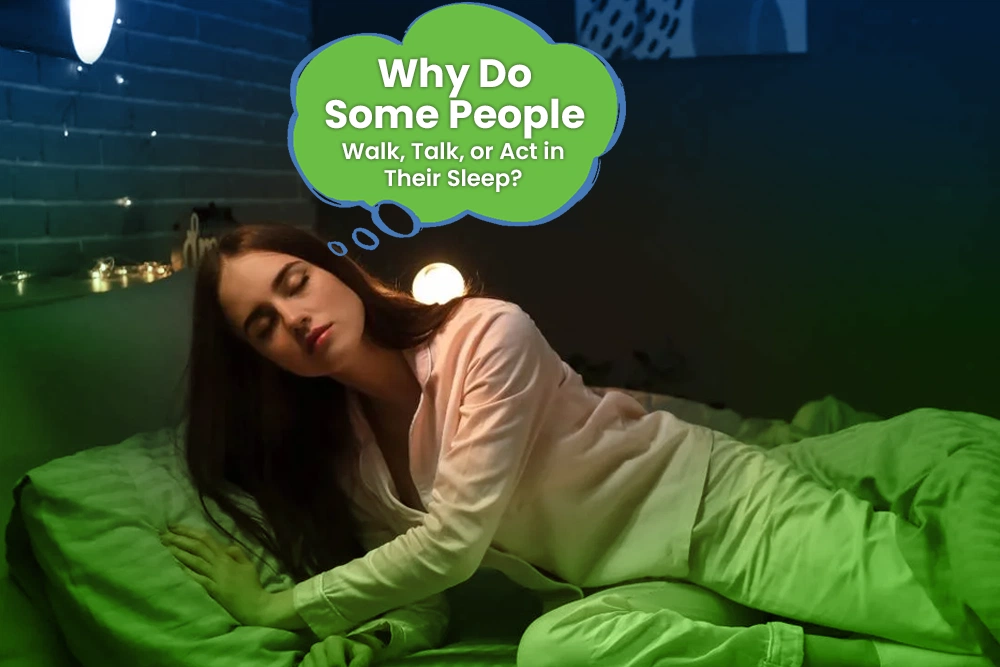
Imagine waking up in the morning and you have been told that you were walking around the house, having a conversation and acting weird while you were asleep… Shocked? But for many people including you it might be a real experience . These unusual activities can be quite shocking and frightening for somebody who witnesses it. I also understand that it feels quite abnormal but this is the truth and all this is known as Parasomnia.

What is Parasomnia?
Parasomnia is a category of sleep disorders that involve abnormal activities, behaviours, experiences that occur during falling asleep, sleeping, wakefulness and in between stages. These behaviours might include walking, talking, screaming, acting weird or acting out the dreams. They usually occur during certain sleep stages like wakefulness, REM sleep, NREM sleep and their combinations. All these sleep cycles are linked to the disruption in the brain’s sleep cycle.
The two major types of the condition are:
- Non-rapid eye movement (NREM) related parasomnia
NREM related parasomnia is again divided into:
- Confusional arousals
- Sleep walking (Somnambulism)
- Sleep terrors
- Sleep related eating disorder
- Rapide eye movement (REM) related parasomnia
REM related parasomnia is further divided into:
- REM sleep behaviour disorder
- Hypnogely
- Recurrent isolated sleep paralysis
- Nightmare disorder

Why do people walk, talk or act in their sleep?
Sleep behaviours usually occur when the brain is partially awake while the brain is in a sleep state. The major causes of these unusual nighttime behaviours are:
- Sleep Disruption and Deprivation
Persistent lack of sleep, changing sleep schedules, jet lag, travelling or such conditions can cause disruption in sleep
- Genetics & Family History
Sleepwalking and parasomnia often runs in the family. Individuals with relatives who experience such kinds of behaviours might be highly prone to develop such conditions.
- Stress & Mental Health
High levels of emotional stress can disturb sleep patterns and increase the likelihood of sleep talking, night terrors, or sleepwalking.Emotional triggers, depression, anxiety, post traumatic stress disorder (PTSD) are the common triggers.
- Neurological conditions
Neurological conditions such as Parkinson’s disease, dementia, epilepsy or other brain disorders could be a factor that influence sleep disorder during the sleep cycle.
- Substances and Medications
Medications and other substances can be a factor that affects sleepwalking and night terrors. Some medications might affect the brain’s functioning and may increase the chances of abnormal sleep behaviour.
- Age-related factors
Children may be more prone to NREM parasomnia due to brain maturity while REM related parasomnia is more common in adults.
Common Sleep Behaviours Explained
-
Sleep walking
Sleep walking occurs when a person gets out of the bed while still being fast asleep. It is also known as somnambulism. The most common sleep walking is seen in children around the age group of 11 and 12 years. The prevalence of sleepwalking is 1-17% in children while it is just 4% in adults. Episodes often occur between deep non-REM sleep cycles and can last from a few seconds to minutes.
People who sleep walk may:
- Walk around the house
- Perform routine tasks
- Move items around the house
- Undress themselves
After doing all these things, if that person gets up from sleep he might not remember anything or be confused about the situation. Sleep walking can be associated with sleep talking.
-
Night Terrors
Sleep terror or Night terrors are the most disruptive sleep disorder. It may involve screaming, rapid breathing, panic or sweating. In extreme cases, it may involve self harm or property damage. Up to 3% of adults experience night terrors but they are more common in children as compared to adults. Unlike nightmares, the individual experiencing night terrors will not remember anything about the condition in the morning. Night terror is mostly prevalent in individuals who have Post-traumatic Stress Disorder (PTSD).
-
REM Sleep behaviour Disorder
REM Sleep behaviour Disorder (RBD) occurs when the body fails to remain still during REM sleep. RBD in which sleep atonia is present is most common in older patients. Statistically, 90% of RBD patients are male and they are older than 50 years of age. In RBD, the individuals might act out their dreams and may result in injuries to themselves or others. Clinical features of RBD are:
- Enacting the dream
- Vocalization like screaming, talking, shouting or laughing in sleep
- Rapid awakening with immediate recall of dream
- Simple or complex motor activity
- May be associated with neurodegenerative disorder
- Occurs mostly in the second half of the night
- Affects men over the age of 50
- Major risk of injury
Who is more likely to experience Parasomnia?
It can affect anyone but certain populations are more susceptible to the condition like:
- Children
Sleep walking and talking are most common in children because their brain is still developing.
- Individuals with other sleep disorders
Individuals that live with sleep disorders like Obstructive sleep apnea, Narcolepsy and Shift worker Sleep Disorder can be more susceptible to the condition more than the normal people.
- Adults with stress or irregular sleep
Adults who experience high stress levels or irregular sleep schedules may be more likely to experience sleep disturbances.
Diagnosis of Parasomnia
Diagnosis of the condition majorly depends on the power of questionnaires. These questionnaires include a detailed analysis of the clinical history and consist of questions to rule out sleep deprivation, effects of intoxication and withdrawal, sleep disorders causing sleep instability. A sleep diary could also be helpful to exclude the concern that sleep deprivation could be a factor for the condition.
Polysomnography is only required in case of RBD. The use of actigraphy can be beneficial in the diagnostic assessment of NREMS related parasomnia to rule out sleep disorders that could contribute to the disorder. There is no correct method to diagnose whether the condition is due to parasomnia, nocturnal seizures or any other neurological condition.
Can Vilafinil 200 mg be used for the treatment of Parasomnia?
Vilafinil is not typically prescribed as a treatment option for Parasomnia. What it can help with is the linkage between this condition and certain sleep disorders. For example it can be used for:
- In people with Narcolepsy, parasomnia-like behaviour can influence the sleep cycles. Vilafinil 200 mg helps improve daytime alertness.
- In individuals with Obstructive Sleep Apnea, Vilafinil 200 mg can improve daytime wakefulness and reduce fatigue related to the condition and improve overall sleep regulation.
In such situations, the medication helps manage symptoms associated with sleep disruption rather than directly treating the disorder itself. Use the medications only under the supervision of a medicinal practitioner.
How does Vilafinil 200 mg work in the brain?
Vilafinil 200 mg works by stimulating wakefulness centers in the brain. It influences the neurotransmitters like histamine and dopamine that regulate the sleep-wake cycle and alertness in the brain. This action helps to improve:
- Daytime alertness
- Reduce excessive sleepiness
- Stabilize sleep-wake cycle
By regulating these processes, Vilafinil 200 mg promotes sleep wake cycle along with alertness that is necessary to support people with sleep disorders that can affect the condition.
When physicians may prescribe Vilafinil 200 mg?
Physicians might prescribe Vilafinil 200 mg if it is associated with the following sleep disorders:
- Narcolepsy
- Obstructive Sleep apnea
- Shift worker Sleep Disorder
In all these cases, Modafinil will work in improving the symptoms seen in these conditions like excessive daytime sleepiness, mental fatigue and fog, etc which will also help in restoring a healthier sleep rhythm.
When should you be concerned?
Most sleep behaviours are harmless, but you should consult a healthcare provider when:
- Episodes happen frequently
- The person injures himself or others
- The patients behaviour turns very aggressive or dangerous
- There is severe daytime sleepiness
The physician might advise some tests to record brain activity, breathing patterns and body movements during sleep for such concerns.
Tips to Reduce Sleep walking and other Parasomnia
When it comes to reducing any symptoms there are always some tips that work like magic but they need to be followed generously. Let me jot down some tips for you:
- Follow a sleeping schedule
Following a sleeping schedule even on the weekends is going to be a boon for excessive daytime sleepiness. Going to bed and waking up at the same time everyday is going to balance your sleep cycles.
- Improve sleep environment
Sleeping in a bad environment is going to trigger your sleep for sure. Dim your room lights, use eye masks if necessary, create a cosy and safe environment for sleeping. All these factors will improve the quality of your sleep.
- Create a relaxing routine
Reduce stress and anxiety before going to bed by reading, taking a warm bath, listening to good music and practicing deep breathing to calm the nervous system. As your nervous system is relaxed it will help in maintaining a sound sleep.
- Avoid Triggers
There are so many triggers in the environment that can affect your sleep. Some of the triggers are alcohol, caffeine, and non-prescribed sedatives which can affect the episodes directly.
- Safety
For sleepwalking patients, some measures should be followed like locking the doors, keeping the invasive things away, removing obstacles that will help in prevention of injuries.
Conclusion
Sleepwalking, sleep talking and other abnormal activities that are seen when you are asleep are collectively known as Parasomnia. These conditions occur when the brain becomes partially awake during sleep, leading to behaviors that may seem strange but are usually harmless.
Although this condition is often temporary and more common in children, persistent or severe episodes may require medical evaluation. Vilafinil 200 mg can help patients with sleep disorders that are also facing this condition. By improving sleep habits, reducing stress, and maintaining a healthy sleep routine, many people can reduce the frequency of these nighttime behaviors and enjoy more restful sleep.
FAQs
- Is parasomnia a mental illness?
No. It is not a mental illness. It is just a group of sleep disorders that involves abnormal, motor or verbal events.
- What are the two main types of Parasomnia?
The two main types are Non-rapid eye movement (NREM) related parasomnia and rapid eye movement (REM) related parasomnia.
- Is parasomnia harmful?
Parasomnia can be concerning because they can lead to poor health effects, disrupted sleep and injuries to self or others.
- What triggers sleepwalkers?
Sleepwalkers are triggered by genetics, sleep deprivation, stress, irregular sleep schedules, fever, and certain medications.
- What is the diagnostic test for Parsomnia?
Tests that can be done to help diagnose this condition include: Sleep study (polysomnogram) Video electroencephalogram (EEG) or sleep EEG.

Leave a Reply