
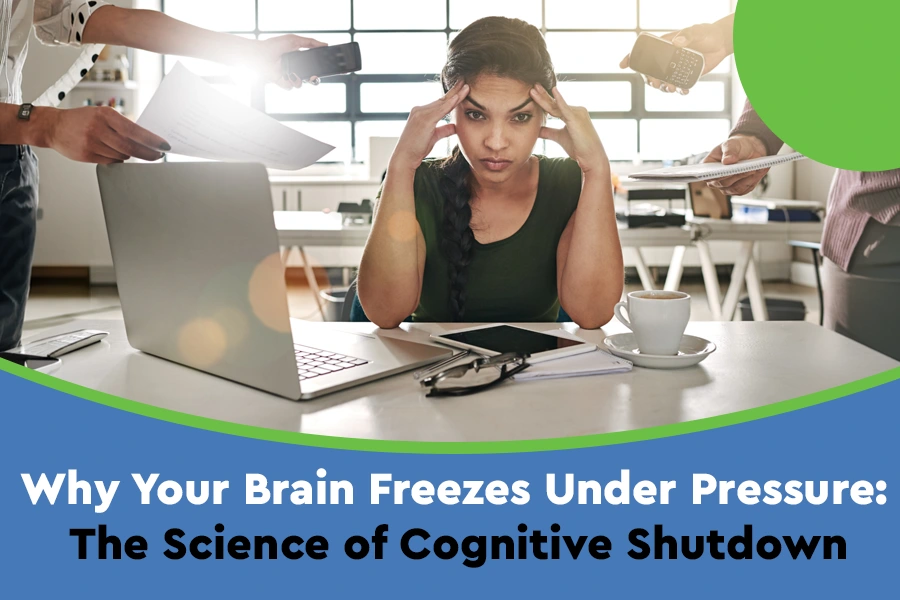
You know that feeling. You’re in the interview, or the exam, or standing at the free throw line, and your brain just… stops. Does not slow down. Stops. Like someone unplugged something.
I’ve been trying to figure out why this happens for a while now, mostly because it’s happened to me more times than I’d like to admit. And the more I read about it, the more I realize nobody really has a clean answer. It’s messy. The science is messy too, honestly.
So let’s just get into it.
The moment it actually happens
There’s this split second where you can feel it coming. Your chest tightens a bit. Your thoughts start moving too fast and then, weirdly, not at all.
That’s basically what people mean when they talk about brain freezes under pressure. It’s not that your brain runs out of information. It’s that access to the information gets blocked somehow.
Kind of like a library where all the books are there but the doors are locked.
Related: What Is Mild Cognitive Impairment and How Is It Different From Dementia?
The amygdala hijack thing
There’s a term for this amygdala hijack where your brain’s threat-detection center basically takes over before your rational brain gets a say.
I think this is the part people don’t really get. Your amygdala doesn’t know the difference between a tiger chasing you and a scary boss asking you a question in a meeting. Both register as “danger.” Both can trigger the same shutdown.
And once that happens, the thinking part of your brain kind of goes offline. Not permanently. Just enough to ruin the moment.
Which, again, brain freezes under pressure aren’t really a failure of intelligence. That’s the part I keep coming back to. Smart people freeze all the time. Maybe more than average, actually, because they’re more aware of what’s at stake.
Working memory overload and why you can’t think straight
Okay so here’s another piece of it. Working memory. That’s the part of your brain holding onto information you need right now, like, right this second while you’re trying to use it.
Under stress, working memory overload happens fast. Like faster than you’d expect. Suddenly you can’t hold three things in your head at once, even though five minutes ago you were fine.
This is why people forget their own phone number when a cop asks for it. Not because they don’t know it. Because the pressure eats up the mental space needed to retrieve it.
I don’t fully understand the neuroscience here, to be honest, but the gist is: pressure takes up bandwidth. And there’s only so much bandwidth to go around.
Prefrontal cortex stress – the part that’s supposed to be in charge
Your prefrontal cortex is basically the CEO of your brain. Planning, reasoning, and decision-making- all of that lives there.
Under prefrontal cortex stress, that CEO basically gets locked out of the building. The amygdala’s running the show instead, and it doesn’t care about nuance or planning. It just wants you safe, right now, by any means necessary.
This is also, I think, why panic makes people do dumb things. Not because they’re dumb. Because the smart part of the brain got benched.
Anyway. Brain freezes under pressure make a lot more sense once you realize this isn’t some random glitch; it’s your brain literally reallocating resources away from thinking and toward survival.
Which is useful if a bear is chasing you. Less useful during a job interview.
The stress response freeze nobody talks about
Everyone knows fight or flight. Fewer people talk about the freeze part.
The stress response freeze is basically your nervous system’s third option: not fighting, not running, just… stopping. Some researchers think it’s an old survival mechanism, like playing dead, except your brain does it even when there’s nothing physically threatening happening.
It’s weirdly common in public speaking. You’d think people would either overexplain (fight) or bail entirely (flight), but a lot of people just freeze mid-sentence. Mouth open. Nothing coming out.
I’ve seen this happen to genuinely confident people. It’s not about confidence, really. It’s about how your nervous system interprets the moment.
Related: Stress Impacts Sleep Quality and Cognitive Function
Fight-flight-freeze and why it doesn’t always look the same
I keep going back and forth on this, but I think fight-flight-freeze reactions look really different depending on the person and, honestly, the day. The same person might handle pressure fine on a good week and completely blank out during a bad one.
Sleep matters. Caffeine matters sometimes in a bad way. Even just how hydrated you are seems to play a role, which honestly kind of annoys me because it makes this feel less controllable than I want it to be.
Yerkes-Dodson law, or why a little pressure actually helps
There’s this old idea called the Yerkes-Dodson law; it basically says performance improves with pressure up to a point, and then it crashes hard after that point.
So a little stress sharpens you. Too much and you’re toast.
The tricky part is that “too much” is different for everyone. What overwhelms one person barely registers for someone else. There’s no universal pressure limit, which makes this whole topic harder to give clean advice about.
Choking under pressure in sports vs everywhere else
Athletes talk about choking under pressure constantly. Missed free throws, blown serves, that kind of thing.
What’s interesting is that it’s often the most practiced skills that break down first. Not the hard stuff, the stuff you’ve done a thousand times. Some researchers think overthinking a usually-automatic skill is what causes it. You start consciously controlling something your body used to do without thinking, and it falls apart.
I don’t know if that fully applies outside sports, but it feels similar to blanking on a presentation you’ve rehearsed a hundred times. The rehearsal isn’t the problem. The overthinking in the moment is.
Anxiety blank mind the exam room version
Everyone’s had the anxiety-blank-mind moment during a test. You studied. You knew this stuff yesterday. And then the exam starts, and it’s just… gone.
This connects back to working memory again; I think pressure eats up the space you’d normally use to retrieve information. It’s not that the knowledge left your brain. It’s locked behind a door that pressure slammed shut.
Annoyingly, worrying about forgetting makes you more likely to forget. Which feels unfair, honestly.
Performance under pressure isn’t really about willpower
I used to think performance under pressure was just a mental toughness thing. Like some people have it and some don’t.
Now I’m less sure. It seems more like a mix of nervous system wiring, practice, sleep, and honestly a bit of luck depending on the day.
Brain freezes under pressure happen to people who are extremely capable in low-stress settings. That’s kind of the whole point: competence and composure aren’t the same skill.
So what actually helps
I don’t have a perfect fix. Nobody does, really.
But slow breathing seems to help pull the prefrontal cortex back online, something about signaling safety to the nervous system.
Practicing under mild pressure, not just in comfortable conditions, seems to help too. Like training your brain to expect a bit of stress so it doesn’t treat every stressful moment as a five-alarm fire.
And honestly, just accepting that brain freezes under pressure happen sometimes, not fighting the fact that it happened seems to shorten how long it lasts. Fighting the freeze seems to make it worse, weirdly.
I don’t fully buy every tip out there. Some of it feels like recycled advice dressed up as science. But the breathing thing, at least, has decent backing.
Anyway
This is one of those topics where the more you read, the less certain everything feels. Which is maybe the most honest thing I can say about it.
Brain freezes under pressure aren’t a character flaw. They’re just what happens when an old survival system meets a modern situation it wasn’t built for.



Leave a Reply