
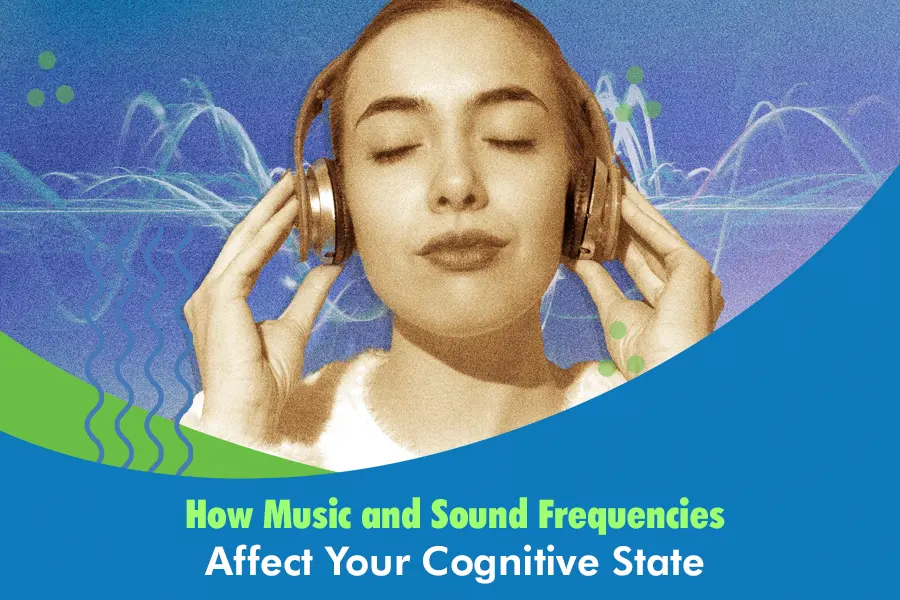
Ever notice how one song can completely flip your mood in like thirty seconds? One minute you’re staring blankly at a spreadsheet, next minute a random guitar riff comes on and suddenly you’re… awake? Focused? Kind of annoyed you weren’t listening to it an hour ago? That’s not a coincidence, and it’s not just “vibes” either, even though it feels that way. There’s actual stuff happening in the brain when sound hits it, and it changes your cognitive state more than most people realize. Not in some mystical way, just… biology doing its thing.
People throw around terms like brain waves and binaural beats like everyone already knows what they mean, but honestly most of us just nod along. So let’s actually get into it, a little messily, because that’s kind of how this topic works anyway.
Sound Isn’t Just Background Noise, Apparently
For the longest time I think most people (myself included, before I started digging into this) assumed music was just… entertainment. Something you put on while doing chores or driving. But turns out your brain is constantly processing sound whether you’re paying attention or not, and that processing directly ties into cognitive function – memory, attention span, even how well you problem-solve.

There’s this whole body of research now, some of it decades old actually, showing that certain frequencies can shift brain activity into different states. Not overnight miracle stuff. More like… nudging. Your brain naturally cycles through different wave patterns – alpha, beta, theta, delta, gamma, there’s a bunch of them – and each one is loosely tied to a different mental state. Beta waves show up when you’re alert and thinking hard. Alpha shows up when you’re relaxed but still awake. Theta is more of that drifty, almost meditative zone.
Music, especially certain rhythms and frequencies, seems to nudge your brain toward matching that rhythm. It’s called entertainment, if you want the technical word for it. Kind of like how you unconsciously tap your foot to a beat – except it’s happening inside your skull too, not just your foot.
Okay So What Are Binaural Beats Actually
This is where people either get really into it or roll their eyes, there’s not much middle ground. Binaural beats happen when you play two slightly different frequencies in each ear – like 200 Hz in the left, 210 Hz in the right – and your brain, trying to make sense of the mismatch, perceives a third “phantom” frequency, which in this case would be 10 Hz. That imaginary beat is what supposedly nudges your brain waves toward a specific state.
Sounds a little sci-fi, I know. And to be fair, the research is mixed. Some studies show real, measurable shifts in mental clarity and relaxation. Others show basically nothing beyond what you’d get from any calming sound. So it’s not some guaranteed hack, more like a tool that works better for some people than others. Worth trying though, honestly, since it costs nothing except fifteen minutes and a pair of headphones.
I’ll say this – a lot of people report using binaural beats for stress relief before an exam or a big meeting, and whether that’s the frequency of doing the work or just… the ritual of sitting still and putting headphones on, hard to say. Probably both.
Music Therapy Isn’t Just For Hospitals
When you hear “music therapy” the image that pops up is usually some clinical setting, someone recovering from a stroke or working through trauma with a licensed therapist and an acoustic guitar. And yeah, that’s a real and legit use case, there’s decades of clinical evidence behind it for things like anxiety, depression, even motor skill recovery.
But it’s kind of broader than that too. In a much more everyday sense, people already do informal music therapy on themselves without calling it that. Sad breakup? Sad playlist. Need to get pumped before a workout? Aggressive playlist. That’s cognitive and emotional regulation happening through sound, just… unofficial and unstructured.
The interesting part is how specific the effects can get. Slower tempo music, somewhere around 60-80 beats per minute, tends to sync up with resting heart rate and can lower cortisol levels – that’s the stress hormone, in case that wasn’t obvious. Faster tempo tends to do the opposite, raising alertness, sometimes raising anxiety too if it’s too aggressive or chaotic sounding.
Brain Waves, Frequencies, and Why This Isn’t As Simple As It Sounds
Here’s where I have to admit the science gets messier than most wellness blogs make it seem. Not every frequency does what people claim. There’s a lot of marketing around “432 Hz healing music” or specific tones that supposedly align with the universe or whatever – and look, maybe there’s something to some of it, but a lot of it isn’t backed by solid research. It’s more folklore-meets-wellness-culture than actual neuroscience.
What is backed by research, at least reasonably well, is that rhythmic, repetitive sound patterns can influence attention and relaxation. Not because of some magic number attached to the frequency, but because rhythm itself is something the brain latches onto naturally. We’re wired for pattern recognition. A steady beat gives the brain something predictable to lock onto, and predictability tends to calm the nervous system down. Chaos does the opposite.
So when someone says a certain frequency “unlocked” their focus, it’s probably less about the specific Hz number and more about the structure of the sound itself – steady, repetitive, not too jarring.
Using Sound For Mental Clarity Without Overthinking It
You don’t need fancy binaural beat apps or $200 noise-canceling headphones to get some benefit here, though sure, those help. Simple stuff works too. Instrumental music without lyrics tends to help with focus more than songs with words, mostly because your brain isn’t splitting attention trying to process language while also trying to work.
Nature sounds – rain, ocean waves, that kind of white-noise-adjacent stuff – also show up a lot in cognitive function research, especially for tasks requiring sustained attention. There’s something about that consistent, non-distracting texture of sound that just… keeps the brain in a steadier lane.
And honestly, silence matters too. People forget that. Constant sound stimulation, even “good” sound, can eventually overload cognitive processing. Sometimes the best thing for mental clarity is turning everything off for twenty minutes. Not glamorous advice, but true.
Stress Relief Through Sound Isn’t New, It’s Just Rebranded
Humming, chanting, drumming circles, lullabies – humans have been using rhythmic sound for stress relief and altered mental states for basically all of recorded history. Binaural beats and curated Spotify “focus” playlists are really just the modern packaging of something ancient. Which is kind of a nice thought actually, that this isn’t some new-age gimmick, it’s just an old idea wearing new headphones.
The nervous system responds to rhythm and tone in ways that don’t really change much generation to generation. What changes is how we deliver it – apps instead of drums, algorithms instead of shamans. Same underlying mechanism though, more or less.
So Does It Actually Change Your Cognitive State
Short answer, yes, to a degree. Long answer – it depends on the person, the type of sound, the context, and honestly the mood someone’s already in before they hit play. Music and frequency aren’t magic switches that flip cognitive function on command. They’re more like gentle levers. Sometimes barely noticeable, sometimes surprisingly strong. Decent sleep and healthy mental health is highly affected by technology.
If someone’s expecting a specific frequency to instantly transform their brain into peak productivity mode, that’s probably setting up for disappointment. But as a supportive tool, alongside decent sleep and normal stress management, sound absolutely plays a role in shaping mental clarity and emotional regulation. It’s not the whole puzzle. Just one piece that happens to be really accessible – a phone and headphones is basically all it takes.




Leave a Reply