
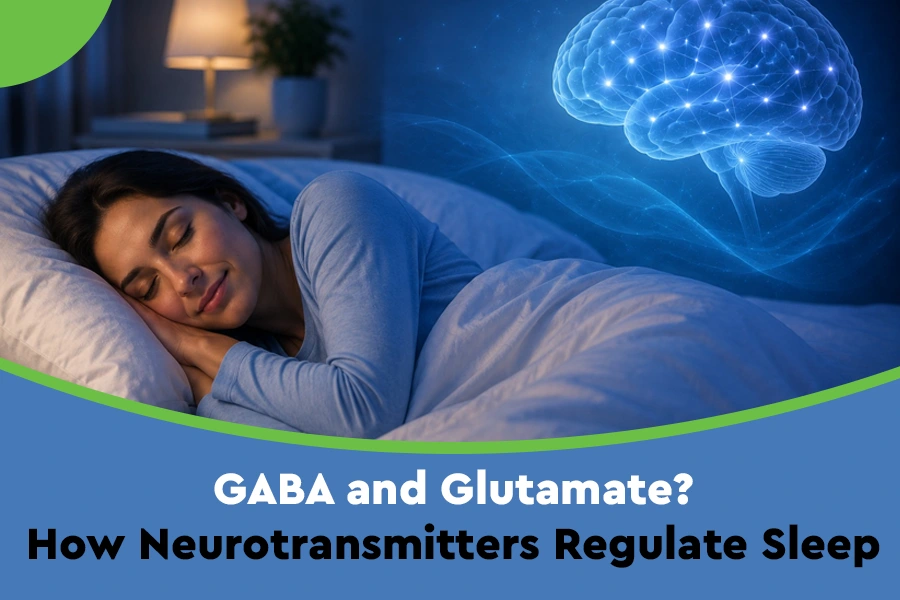
Every night, your brain does this careful hand over from being alert to just, you know, dropping out. The whole thing is pushed along by chemicals, and two of the biggest players are GABA and glutamate. Glutamate feels like the brain’s main accelerator, and GABA is basically the brake. Together they decide if you’re going to feel wired or sleepy, and also if the night is smooth or all fragmented and weird. With around 30 percent of adults saying they get insomnia symptoms and roughly 10 percent who actually meet the chronic insomnia disorder criteria, this balance isn’t just trivia; it has real everyday use.
The Accelerator and the Brake
Glutamate is the most common excitatory neurotransmitter in the central nervous system, and it shows up in an estimated 80 to 90 percent of excitatory synapses in the cortex. It supports learning, memory, and that wakefulness push. GABA (gamma-aminobutyric acid) is the counterpart. About 30 to 40 percent of synapses use it, and it tones down neural activity by making neurons less likely to fire. The brain even builds GABA from glutamate using an enzyme called glutamic acid decarboxylase, which pretty much shows how tightly those two are linked. A brain that works well seems to rely on keeping GABA and glutamate in balance, and sleep is one of the clearest places where you can see that balance being used.
Flipping the Switch Between Wake and Sleep
The sleep-wake cycle is like a seesaw, and during the day arousal centers in the brainstem and hypothalamus send out glutamate, histamine, orexin, and other chemical signals that keep the cortex humming. Then, as bedtime comes, a cluster of neurons in the hypothalamus called the ventrolateral preoptic nucleus basically flips on. These cells release GABA onto the arousal centers and shut them down, effectively turning them off. That’s the role of GABA in sleep; it quiets the wake-promoting pathways so sleep can start and then stay steady. Because the two sides inhibit each other, the brain tends to switch states pretty firmly, instead of floating in between for ages in the case of GABA and glutamate.
Mapping a Night of Sleep
This chemical back-and-forth shapes your sleep architecture in GABA and glutamate. A typical adult needs seven to nine hours and usually runs four to six rounds, with each one lasting about 90 minutes. Roughly 20 to 25 percent of the night is REM, and about 13 to 23 percent is deep slow-wave sleep, and the rest is lighter stages. If you get a clearer picture of REM and non-REM sleep, the chemistry makes more sense. During deep non-REM, GABA-driven inhibition is strong, so you get synchronized slow waves. In REM, glutamate driven activity rises again, the brain looks more like it does when you’re awake, and GABA and other inhibitory signals keep your muscles from moving much, so you don’t act out your dreams. So, sleep regulation in the brain is more like a planned sequence of activation and suppression.
Why You Get Sleepy and Why You Wake Up
GABA and glutamate systems decide when you sleep. First, there’s sleep homeostasis, which is basically sleep pressure building up the longer you stay awake. Adenosine stacks up during wakefulness and nudges those GABA releasing sleep circuits to turn on. You can even measure the impact: staying awake for 24 hours can impair performance about like having a blood alcohol concentration around 0.10 percent. Second is the body clock. The suprachiasmatic nucleus, a cluster of about 20,000 neurons in the hypothalamus, keeps time on a 24 hour cycle, and nearly all of those neurons use GABA. This is where circadian rhythm and neurotransmitters come in. Light signals reach the clock through glutamate released from specialized cells in the eyes, and then the clock adjusts GABA and melatonin signaling to line up sleepiness. When sleep pressure and circadian timing match, sleep arrives pretty easily. When they fight, like with jet lag or shift work, it doesn’t.
When the Balance Tips
There’s evidence suggesting that GABA imbalance and insomnia are linked. One brain imaging study reported that people with primary insomnia had GABA levels about 30 percent lower than good sleepers, even if findings vary across studies. If glutamate is too active, or if GABA is underactive, the brain can get stuck in hyperarousal mode, with a racing mind, a fast heartbeat, and real trouble turning off. Chronic stress, caffeine, and sleep loss can all push things in that direction. A lot of medicines also try to push the same lever by boosting GABA signaling. Benzodiazepines and “Z-drugs” bind to GABA-A receptors to strengthen inhibition, and that’s part of why they can help you fall asleep, but also why GABA and glutamate come with risks like dependence and changes in sleep stages with long-term use.
Nature’s Nudges: Supplements and Minerals
Many people prefer something gentler regarding GABA and glutamate. L-theanine, an amino acid found in tea leaves, gets studied next to GABA because it seems to increase GABA activity and reduce glutamate-driven arousal. In one four-week trial of healthy adults, 200 mg of L-theanine each day improved multiple sleep quality measures. The overall evidence for L-theanine and GABA is still limited, though, and any effects look modest, not dramatic.
magnesium and GABA for sleep can help regulate receptors and also calm excitatory glutamate receptors. In a small trial with older adults, 500 mg of magnesium every day for eight weeks improved insomnia measures. That point matters because many people are not getting enough: nearly half of US adults consume less magnesium than they need, and the recommended daily intake is about 310 to 420 mg depending on age and sex. Taking GABA itself as a supplement is less clear, since it’s uncertain how much actually crosses the blood brain barrier. You should check with a healthcare provider before starting supplements, especially if you take medication or have kidney problems.
Helping Your Brain Find Its Balance
You can support the GABA and glutamate system without any pill. try to keep a regular schedule, because your circadian clock really leans on consistency, not just “close enough”. Get bright light early in the morning, then dim things in the evening. Also cut caffeine by early afternoon, since it blocks adenosine and keeps that glutamate-driven arousal running a little higher. Alcohol might make you feel sleepy at first; it tends to boost GABA, but it also messes with the second half of the night and can suppress REM sleep, so things feel lighter… but actually worse. Regular exercise helps, and so does a cool, dark bedroom with some wind-down routine. These things lower evening arousal, even if your mind is still a bit chatty. If insomnia keeps going for three months or more, cognitive behavioral therapy for insomnia is often recommended as a first-line treatment, and it works for roughly 70 to 80 percent of people who try it.
Brief To Conclude
Sleep isn’t just the absence of being awake. It’s an active process, sort of shaped by the push and pull between GABA and glutamate, while adenosine and your body clock set the timing. When that balance stays put, you fall asleep more naturally and you go through healthier cycles. When it tilts, insomnia and fatigue usually show up. Supporting the system with steady habits, adequate magnesium, and professional guidance when needed gives your brain its best shot at getting the rest it actually needs.

Leave a Reply