
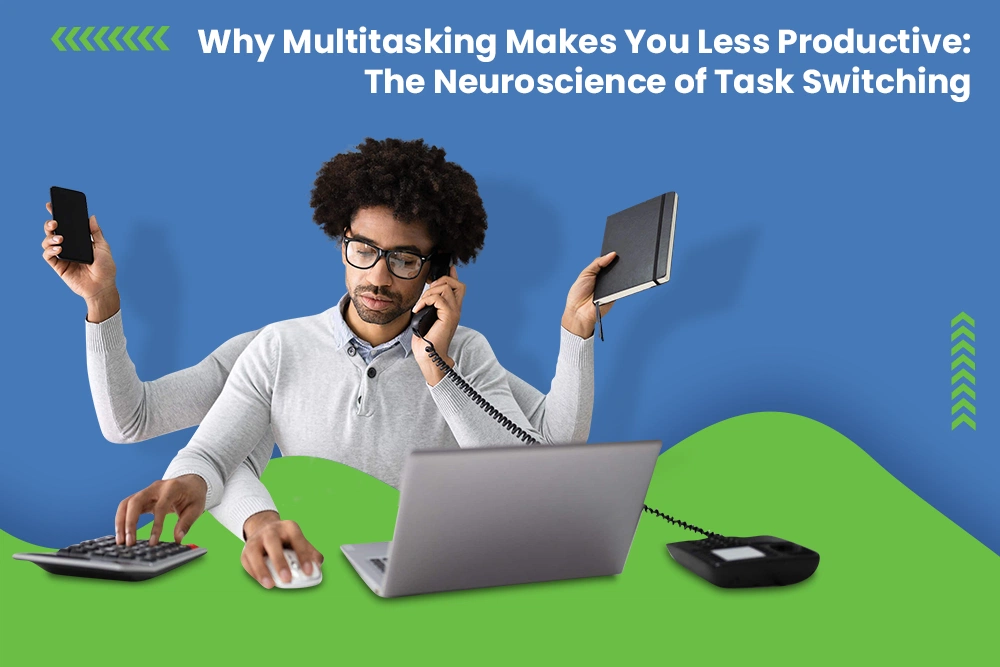
Most of us still think we are good at multitasking.
You answer a message while writing an email. You listen to a meeting while checking a spreadsheet. You start working, then open a news tab “for two minutes,” then somehow it is 25 minutes later and you are not fully sure what you were doing before.
It feels productive because things are happening.
But multitasking makes you less productive in a very ordinary, slightly annoying way. Your brain is not really doing several demanding things at once. It is moving back and forth between them, often faster than you notice.
That switch has a cost.
Sometimes it is small. Sometimes it completely ruins the flow of the day.
It is not really multitasking, is it?
There are a few things humans can combine fairly well. Walking and talking. Folding laundry while listening to a podcast. Making tea while thinking about what to cook later.
But two tasks that both need attention? That is different.
Writing a proposal while replying to Slack messages is not two things at the same time. It is writing, stopping, reading, deciding how to reply, replying, trying to remember the sentence you were writing, and then continuing. Or pretending to continue.
This is where the idea of cognitive switching matters. The brain has to disengage from one mental setup and load another one. You have to remember the goal, the rules, the tone, and the details. Even if only for a few seconds.
Then you switch back and do it again.
It sounds minor. It is not always minor.
The little delay adds up fast
A single interruption may take 10 seconds. Maybe less.
But the interruption itself is only part of the problem. The real issue is the mental restart. You read a message, process it, make a decision, perhaps feel mildly irritated by it, and then try to return to your original work.
Your eyes are back on the document, but your thoughts have not really caught up.
That is one reason multitasking makes you less productive, even when you think you are working all day. You may be sitting at your desk for eight hours, moving constantly, answering everything quickly, and still finishing less meaningful work than you expected.
There is a strange gap between being busy and getting something done.
Most people know that feeling already. They just do not always connect it to switching tasks every few minutes.
Your brain leaves part of itself behind
When you stop one task and move to another, some of your attention can stay attached to the first task.
This is called attention residue. It is basically the leftover mental noise from whatever you were doing before.
Maybe you were editing a difficult paragraph, then checked an email from your manager. You return to the paragraph, but now a part of your mind is still replaying the email. Did they sound annoyed? Do you need to respond now? Did you miss something?
You are technically back at work.
You are not fully back at work.
That unfinished feeling can be worse when the first task was important, emotionally loaded, or incomplete. A half-written report tends to pull at the mind. So does a difficult phone call. So does a message that says, “Can we talk later?”
Not ideal.
Notifications are not as harmless as they look
A notification seems tiny. A little sound. A banner in the corner. A glance at a lock screen.
But it can split your attention before you even respond to it.
You may tell yourself, “I didn’t click it.” Fair enough. Yet you still read enough to wonder what it meant. You still register the name, the subject line, and the urgency. Your brain has opened a door, even if only halfway.
This is part of why multitasking makes you less productive in modern work settings. It is not just about doing two big jobs at once. It is also about the steady stream of micro-interruptions that never quite let your mind settle.
Email. Chat. Calendar alert. Phone buzz. Another tab. Someone is asking a quick question.
The workday can become one long series of almost starts.
The brain likes clarity more than chaos
Your brain needs some time to understand what matters right now.
When you work on one task for a while, you build momentum. You remember where you were. You begin to see connections. You make fewer basic mistakes because the context is already sitting in your mind.
Switch too often, and that context keeps disappearing.
This is especially obvious with complex work: writing, coding, analysing data, planning a campaign, reviewing medical information, and solving a tricky problem. These tasks need more than time. They need a kind of mental runway.
You cannot always land and take off again every three minutes.
Well, you can. But it is exhausting.
And then people assume they are tired because they worked hard. Sometimes they are tired because they kept changing mental channels all day.
The myth of being “good under pressure”
Some people say they work best when things are hectic.
Maybe that is true in certain situations. Emergency teams, customer support roles, busy clinics, and operational jobs often require rapid decisions. There are real jobs where responding quickly to several demands is unavoidable.
But constant urgency is not the same as good work.
You can become skilled at switching. You can get used to noise. You can learn to manage interruptions better than someone else. That does not mean the brain suddenly performs deep thinking without a cost.
Even experienced workers can lose accuracy when demands pile up. They may miss details, make rushed choices, or take longer to finish something that should have been simple.
So yes, some people handle chaos better.
Still, multitasking makes you less productive when the task requires concentration, memory, judgement, or creativity. Which is a lot of work, honestly.
You may finish more small things and fewer important things
This is where multitasking gets sneaky.
You can clear messages. You can respond to comments. You can rename files, approve small requests, check updates, rearrange a calendar, and feel very efficient.
Those tasks matter sometimes. They are not pointless.
But they can also become a comfortable escape from the harder job sitting in front of you. The article that needs writing. The strategy you keep avoiding. The report that requires actual thought.
Small tasks give quick closure. Deep work usually does not.
So you switch. Then switch again. And by the end of the day, your inbox looks better but your main project looks exactly the same.
That is not laziness. It is just an easy pattern to fall into.
The “just one quick check” problem
A quick check is rarely just a quick check.
You open social media to see one message. There is an interesting headline. Then a video. Then a comment. Then you remember an email you meant to send. You send it. Then you go back to work, except your concentration is now scattered in six directions.
This is why multitasking makes you less productive even when each distraction seems harmless on its own.
Nobody usually decides, “I am going to destroy my focus for the afternoon.”
It happens through tiny choices that feel reasonable in the moment.
One minute here. Two minutes there. Another glance. Another reply.
The brain does not experience that as nothing.
You do not need a perfect focus routine
The answer is not to become one of those people who wakes up at 5 a.m., drinks something green, locks their phone in a drawer, and works in complete silence for six hours.
That might work for someone. It might also sound unbearable.
You probably just need fewer unnecessary switches.
Try working on one meaningful task for a defined stretch of time. Not forever. Maybe 25 minutes, maybe 45. Put chat notifications away during that period if you can. Keep a scrap note nearby for random thoughts, reminders, and things you suddenly want to look up.
Write them down instead of chasing them immediately.
It feels a little boring at first. Your brain may keep reaching for the usual stimulation. That is normal.
The goal is not flawless concentration. It is giving your mind a chance to stay with something long enough for the work to get easier.
That is where focus and productivity start to improve, though not in a dramatic movie-montage kind of way. More quietly than that.
Meetings can make this worse too
A meeting-heavy day creates its own form of brain multitasking.
You move from a planning call to an email thread, from that to a task update, and then to another meeting with a completely different topic. Each one asks you to enter a new context quickly.
By mid-afternoon, your brain may feel oddly full.
Not because you have produced nothing. You probably have done a lot. But because the work was fragmented. You spent the day adjusting rather than moving forward.
If you have any control over your calendar, grouping similar tasks can help. Meetings together. Admin work together. Writing time is protected when possible.
It will not fix every busy day. Nothing really does.
But it can reduce the constant mental rebooting.
A bit of boredom might actually help
This sounds strange, but boredom can be useful.
When you are used to switching constantly, a single task can feel too slow. Your brain wants a reward. A message. A new tab. Something more immediate.
If you stay with the task through that restless moment, you may eventually get past it. You start noticing what the work actually needs. You find the next sentence. You solve the thing that looked impossible 10 minutes ago.
Not every time. But often enough.
And that is probably the bigger point: Multitasking makes you less productive not because people are weak or undisciplined, but because attention is limited. It gets pulled, divided, and restarted all day.
Your brain is doing its best with too many open doors.
It is okay to protect your attention
You do not have to answer every message instantly.
You do not have to keep every tab open. You do not have to check email every few minutes just because you can. Some work needs quiet, even if the quiet only lasts half an hour.
The irony is that doing less at once can help you finish more.
Not always more tiny tasks. Sometimes fewer things, but better things.
And maybe that is more useful anyway.
Because multitasking makes you less productive when it turns your day into constant reaction. Giving one task your real attention is not some luxury habit. It is often the only way to make progress on work that actually matters.
FAQs
- Does multitasking really reduce productivity?
Yes. Switching between demanding tasks takes time and mental energy, even when the switch feels quick.
2. Can the brain multitask at all?
It can combine simple activities, but demanding tasks usually require attention to shift back and forth.
3. Why do I feel busy when I multitask?
You are doing many small actions but frequent switching can stop you from finishing deeper work.
4. How can I stop switching tasks so often?
Turn off nonessential notifications and choose one task to work on for a short focused period.
5. Is multitasking always bad?
No. It can be useful for simple, routine activities. It becomes a problem when both tasks need real concentration.





Leave a Reply