
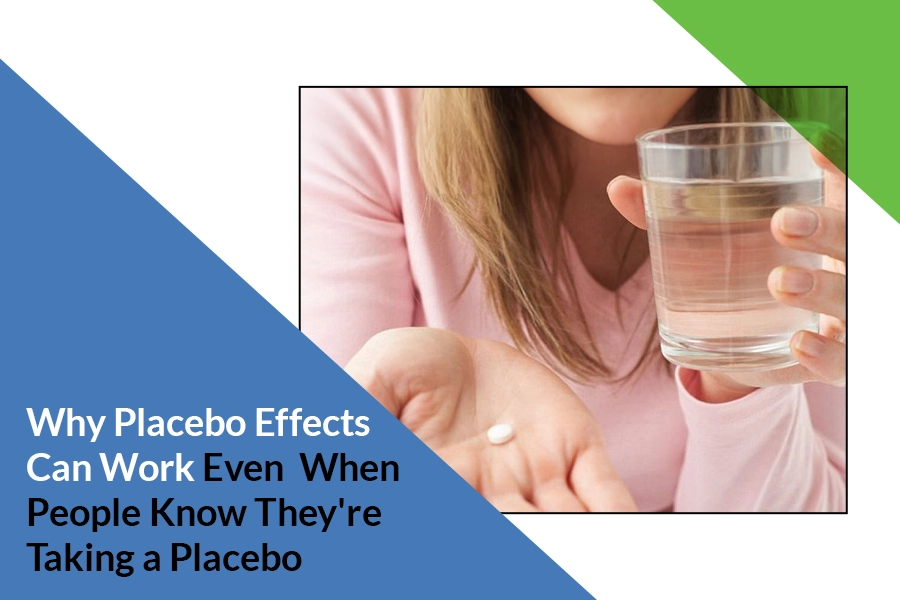
Medicine has a theory that still trips people over, even researchers who’ve been staring at the data for years. You give someone a sugar pill. Like literally a sugar pill and there’s nothing in it. And somehow they still get better. Not always, not dramatically but most of the time and this is what is called open label placebo. It breaks a rule that most of us assumed was basically load-bearing that a placebo only works because the person is fooled.
Turns out that’s not quite true. Or it’s true sometimes and not other times, which is honestly more annoying than if it were just wrong.
What is an open label placebo?
Open Label Placebo is exactly what it sounds like once you break the phrase apart: “open label” meaning nothing is hidden, the patient knows precisely what’s in the bottle, and “placebo” meaning the pill or capsule itself has no active pharmaceutical ingredient. So it’s placebo treatment, minus the secrecy that used to define the whole idea.
Researchers have mostly used this in tests for chronic pain, irritable bowel syndrome, cancer-related fatigue, some migraine work and a smaller pile of anxiety trials. It’s given as a supplement to whatever else someone’s doing for treatment, not instead of it. A physician might say something like, take this twice daily, it’s an inert pill, but patients following this routine in trials have reported real symptom relief that’s basically the shape of how it gets used.
As for benefits, they’re modest but recurring across studies. Reduced pain scores. Better reported quality of life in IBS patients. Less fatigue in some cancer contexts. None of these are jaw-dropping numbers, and nobody serious is claiming otherwise, but they’re consistently better than doing nothing at all, which is really the bar these trials are measured against. There’s also a benefit that’s harder to quantify as patients seem to feel more in control, less like they’re being handled, since they were told the truth from the start. That trust piece keeps showing up as its own small benefit alongside the physical symptom changes.
Related: What is the Placebo Effect?
The old assumption that deception was the whole point
For decades, the working theory was simple enough. Let me explain the placebo effect in a single sentence: The brain responds to expectation, and expectation requires belief, and belief requires not knowing the truth. So the trick is in not knowing. Physicians and researchers leaned on this for ages, and there’s a reason placebo-controlled trials are the backbone of drug testing. You need the comparison, and traditionally you needed the patient in the dark for it to mean anything.
Except then there were a handful of studies conducted by the researchers where the patients knew exactly what they were taking. No con. No white coat mystery. Just here is an inert pill, take it twice a day and outcomes move anyway. Not huge swings usually. But in things like chronic low back pain, IBS symptoms, and some cancer-related fatigue trials, the open label group did noticeably better than the no-treatment group. That’s weird if you think the whole mechanism runs on deception.
What’s actually happening in the body?
Nobody has this fully pinned down, and I think it’s worth just saying that plainly instead of pretending there’s a tidy mechanism. Some of it seems to be conditioning like Pavlov’s dogs but for humans and pill bottles. If you’ve taken real medication for pain before, and it worked, your body may have built an association between the act of taking a pill and feeling relief. The ritual itself-swallowing something, at a set time, with intention might trigger some of the same neurochemical pathways involved in actual pain relief. Endorphins, dopamine, that whole family of things.
There’s also the expectation piece, which doesn’t disappear just because you know it’s a placebo. This is one of the more counterintuitive parts of how placebos work. You’d think knowing kills the expectation. But apparently people can hold two things in their head at once: “this has no active ingredient” and “I expect this process to help me because someone I trust told me it might.” That second belief seems to matter more than logic would suggest it should.
I keep going back and forth on whether this is really about belief in the pill, or belief in the ritual of care itself like the appointment, the prescription pad, someone paying attention to your symptoms. Might be both. Might be neither, and it’s something else entirely we haven’t isolated yet.
Related: Role of Neurotransmitters: Dopamine, Norepinephrine & Orexin
Placebo without deception isn’t something new
Physicians have quietly used placebo approaches for a long time now, sometimes without even admitting it to themselves. Vitamin shots for vague fatigue. Reassurance dressed up as treatment. What’s changed with open-label placebo research is that it’s been dragged into the light and tested properly, with real trial design, instead of being this backroom thing physicians did and shrugged about.
The name most associated with pushing this into legitimate research territory was done by Ted Kaptchuk’s group at Harvard. Their early IBS study back around 2010 is the one people cite constantly where patients told flat out they were getting placebo capsules, and they still reported meaningful symptom improvement compared to people getting no pills at all. That study alone didn’t prove much on its own, studies rarely do, but it opened the door for a wave of replication attempts across different conditions.
Placebo for pain seems to be where the evidence is strongest
If you look across the research that’s accumulated, chronic pain conditions show up again and again as the area where open label placebo benefits look most consistent. Lower back pain trials, migraine studies, even some post-surgical pain contexts have shown modest but real reductions when patients are given placebos honestly. Nobody’s claiming it replaces actual pain management. But as an add-on, something a physician might offer alongside real treatment rather than instead of it, the data’s reasonably encouraging.
Placebo for anxiety is a bit messier, the effect sizes bounce around more between studies, and some of that might just be because anxiety is harder to measure consistently than, say, a pain scale. Still, a few smaller trials have found similar patterns like people informed that they’re taking placebo pills for anxiety symptoms reporting some relief, more than doing nothing.
Why does honesty seem to matter here more than people expected?
Usually honesty itself is the major plus point for most of the things to work. Being told the truth rather than being managed or handled might build trust in patients receiving the treatment. Trust could be the part that can trigger the response. It’s a strange loop that works because you were told that it was placebo, which signals that the person giving it to you respects you enough not to lie.
This connects to something bigger in how mind body healing research has been trending generally. It’s less about placebo as fakery and more about placebo as one channel through which context, ritual, and relationship affect physiology. Which sounds a little new-agey written out like that, but there’s actual neuroimaging work behind some of it like changes in areas tied to pain processing, not just self-reported feelings.
The ethical piece of advice nobody talks about enough
Ethical placebo use used to be kind of an oxymoron because placebo pretty much meant lying to a patient. Open label placebo sidesteps that entirely, which is probably why physicians have gotten more comfortable discussing it publicly instead of just quietly doing placebo-adjacent things and not mentioning it in the notes.
That said, there are real limits worth naming. It’s not a stand-in for treating serious illness. Nobody running these trials is suggesting cancer gets treated with sugar pills instead of chemo. It’s mostly being studied as a complement for symptom management like pain, fatigue, some GI issues, mild anxiety; not as a cure for anything structural.
Power of belief
The phrase “power of belief” gets used a lot in wellness spaces in a way that’s honestly kind of unfalsifiable and a little irritating if you’re trying to think about this scientifically. What the open label placebo data actually supports is narrower and more interesting than that. It’s not “believe hard enough and anything happens.” It’s more like under specific conditions, with specific rituals, delivered by someone trusted, in specific symptom categories, the body’s own regulatory systems can be nudged toward relief. That’s a real, measurable, if modest, phenomenon. It’s not magic. It’s also not nothing.
Honestly the research is still young enough that a lot of the “why” questions remain open. Sample sizes in a lot of these trials are small. Effect sizes are usually modest, not dramatic. And there’s a reasonable chance some of what looks like an open label placebo effect is partly regression to the mean or natural symptom fluctuation, which is a boring but important caveat that doesn’t always make it into the popular coverage of this topic.
Still, the core finding keeps replicating in one form or another: you can tell someone the truth and their body can still respond as if something real happened. That alone is worth sitting with for a minute.
Explore Modafinil products in:
Modafinil In UK, Modafinil In Germany, Modafinil In Europe, Modafinil In Australia
FAQs
There’s real trial data behind it, mostly for pain and some GI symptoms, though effects are usually modest, not dramatic.
No. It’s studied as an add-on for symptom relief, not a substitute for treating actual disease.
Ritual, conditioning, and trust in the person prescribing it seem to matter more than pure belief in the pill itself.
Related but different as regular placebo relies on not knowing; open label placebo works even with full disclosure.
Generally yes, since patients are told the truth upfront, which sidesteps the deception concerns of traditional placebo use.
Leave a Reply