
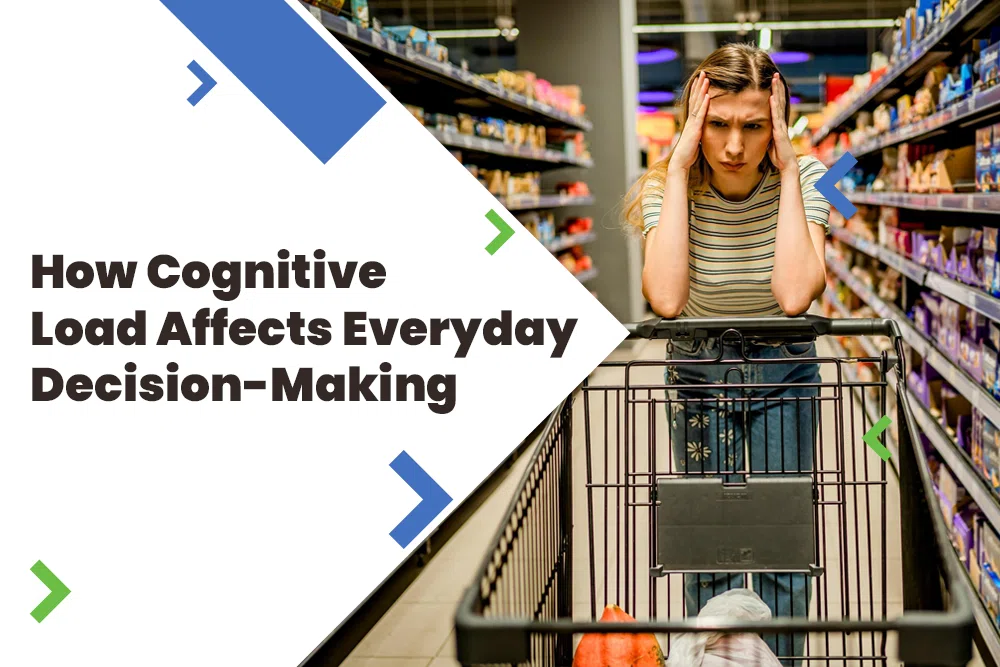
Last Tuesday I stood in my kitchen for about ten minutes trying to decide what to have for lunch. Ten minutes. I had bread, eggs, and half an avocado. It’s not complicated.
But my head was full. Work emails, a dentist appointment I’d forgotten to book something; my sister said that I kept replaying. And the eggs just lost.
That’s basically what this whole post is about.
So what even is it?
Cognitive load is the amount of mental effort your brain is using at any given moment. That’s it. That’s the simple version, and honestly, I think it’s the useful one.
Your brain can only hold so much at once. Researchers have argued about the exact number for decades, somewhere around four things, give or take, which is a lot smaller than most people assume. Everything you’re juggling takes up a bit of that space. The email, the song stuck in your head, the vague worry about money.
When it’s full, it’s full.
And here’s what I didn’t get for ages. It isn’t only about hard tasks. Easy stuff counts too. Tiny choices pile up quietly in the background.
The browser tabs thing
I keep coming back to browser tabs. You know when your laptop gets slow and weird, the fan starts whirring, and you look and there are thirty tabs open? You didn’t do anything big. It was just all the small things left open.
Your brain does that. Every unfinished thing is a tab.
Working memory is the part that holds them, more or less, and it isn’t big. So when you’re trying to pick a phone plan while remembering to reply to your landlord while half-listening to someone talk to you, something gives. Usually the choice.
Every extra bit of cognitive load makes that more likely, even the boring bits you don’t notice yourself carrying.
Usually it’s a bad choice, or a lazy one. Or no choice at all, which is its own kind of choice, I guess.
Related: Link Between Fitness and Cognitive Enhancement
Why dinner feels impossible at 7 pm
This is the one everyone recognizes. It’s evening, you’ve been up since six, and someone asks, “What do you want for dinner?” and you feel a flash of actual irritation. Like they’ve handed you a puzzle.
Some people call it decision fatigue. I don’t love the term because it sounds a bit dramatic, but it fits. Each choice you make during the day takes a little something out of you, and by the evening there isn’t much left.
By then you’re running on a pretty heavy cognitive load, and the brain does what it always does when it’s stretched. It takes shortcuts. So you order the same thing. Or you say “I don’t mind” when you do mind, quite a lot, actually.
I’ve done the “I don’t mind” thing so many times. It’s never true.
To be fair, the research on this is a bit mixed. Some studies have struggled to replicate the big willpower claims. But the feeling is real, whatever the mechanism is. Plenty of people feel it. I feel it.
Too much coming in
Phones, mostly. Let’s be honest.
Notifications, group chats, newsletters you never read, and news that makes your stomach drop. It all arrives whether you asked for it or not. That’s information overload, and it isn’t new, but it has gotten louder.
The strange part is that more information doesn’t make choices easier. It makes them harder. You’d think ten reviews of a vacuum cleaner would help. Instead, you end up with forty-five tabs (see above) and no vacuum cleaner.
I once spent three weeks choosing a kettle. A kettle.
The stuff nobody sees
There’s a lot of invisible thinking in a normal week. Remembering whose birthday is coming up. Knowing the bins go out Thursday, or is it Wednesday this week? Keeping track of who said they’d do what. Planning meals. Wondering if you replied to that message or only thought about replying.
That’s the mental load, and it tends to land unevenly in households, which is a whole other conversation I’m not getting into here.
But it counts. All of it adds to your cognitive load, even when you’re sitting on the sofa apparently doing nothing.
Which is why you can be wrecked after a day where you “didn’t do much.” You did, though. Your head did.
When your head just stops cooperating
Sometimes it creeps up. You reread the same paragraph three times. You walk into a room and forget why. You snap at someone for asking something reasonable.
Cognitive overload is probably the proper name for it, when what’s being asked of your brain is simply bigger than what it can handle right now. It doesn’t feel like a dramatic collapse. More a dull, fuzzy slowness.
Some people call it brain fog. I’ve used that word myself. It’s vague, but you know it when it’s there.
Then there’s mental fatigue, that heavy tiredness behind the eyes after a long stretch of thinking hard. Different from being sleepy, though the two travel together a lot.
Related: How To Fight Mental Fatigue And Stay Productive
Poor sleep, stress, and constant task-switching all chip away at cognitive function, and then even basic decision-making starts to feel clumsy. You second-guess things you’d normally do without thinking. You put off the small stuff, and the small stuff turns into more tabs.
Sleep matters, obviously. Everyone says that. It’s still true.
What actually helps (a bit)
I’m not a fan of tidy productivity advice, so take this loosely. What helps me is mostly boring.
Writing things down, for one. If it’s on paper, it isn’t in my head, and that frees up a surprising amount of room. A list on my phone, a sticky note, whatever works.
Cutting down tiny choices helps too. I eat roughly the same breakfast most days. Sometimes I lay out clothes the night before. It sounds a bit sad, maybe, but it means fewer small calls before nine, and that’s the whole point.
Anything that trims your cognitive load, even slightly, leaves more energy for the stuff that matters.
Big decisions in the morning, if you can. Not at 10 pm when you’re lying in bed spiralling about whether to change jobs. Nothing good gets decided at 10 pm.
And turning off notifications. I resisted this for years. Then I did it for a week and felt weirdly calm. I turned some back on, because I’m not a monk, but not all of them.
None of this fixes everything. Some weeks are just heavy.
Okay, one last thing
I think what bugged me about that lunch moment was that I felt stupid. Like I should be able to pick an egg.
But I wasn’t stupid. I was full. There’s a difference, and it’s easy to miss when you’re in the middle of it.
So if you’re staring into the fridge some evening, unable to choose, maybe it’s not you being useless. Maybe your head’s just got too many tabs open.
Close a few. Have the eggs.



Leave a Reply