
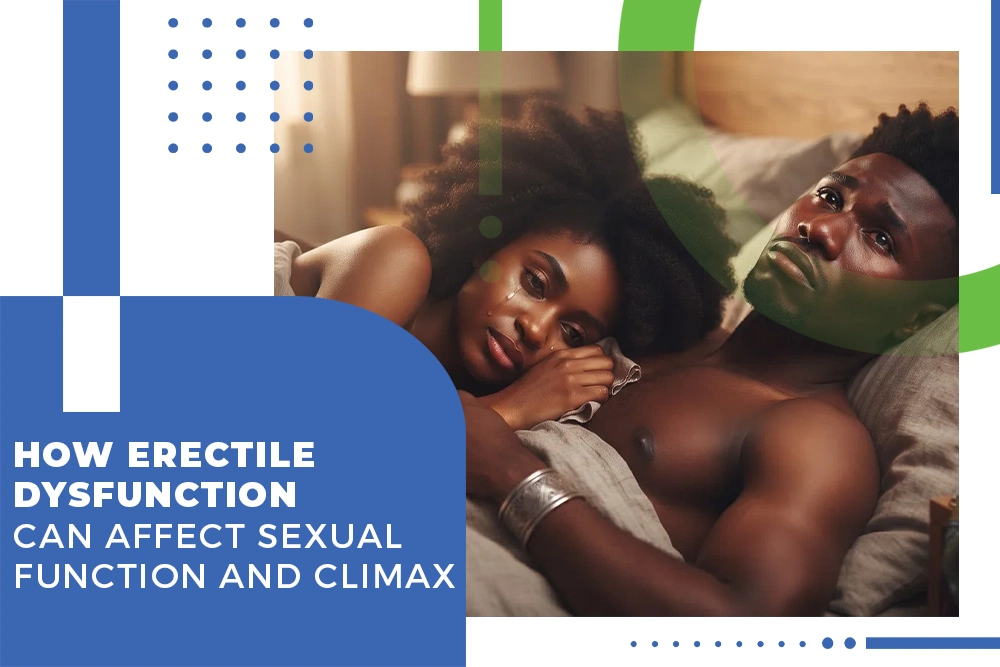
A friend of mine once told me, a bit drunk, that the worst part of his ED wasn’t the erections themselves. It was not knowing what would happen next. Would it show up? Would it stay? Would he even finish?
I’ve thought about that a lot since.
Okay, where do I even start
This stuff is awkward to talk about, so most men don’t. They quietly stop initiating, or blame being tired, or suddenly get very interested in the late film.
What I want to work out here is how ED affects sexual function, and whether climax gets dragged along with it. Short answer: sometimes. The longer answer is messy, and I’ll probably wander off a couple of times.
So what is erectile dysfunction, really?
It means regular trouble getting or keeping an erection firm enough for sex. Regular is the key word. Everybody has an off night after too many drinks, or a rotten week at work, or for no reason at all. One off night isn’t ED.
The usual ED symptoms are plain enough. Erections that never fully arrive, or fade halfway through, or just feel softer than they used to. Some men also notice fewer morning erections, which can be a clue, although plenty of men with ED still get the odd one, so it’s no perfect test.
The causes are all over the place. Blood flow, nerves, hormones, medicines, stress. Diabetes, high blood pressure, high cholesterol, and smoking. Usually it’s a mix of body and head, and each feeds the other, which is why it’s so hard to pin on one thing.
It’s also very common. Millions of men in the US and UK deal with it. That doesn’t make it feel any less personal, though.
Understanding Sexual Function and Climax
I used to think of it like a light switch. Works, or it doesn’t.
It’s more like a chain. Desire first, then arousal (that’s where the erection comes in), then the build-up, then orgasm, often with ejaculation, then either the afterglow or the awkward silence. Any link can wobble on its own.
So when people ask how ED affects sexual function, they usually mean the erection link. But the other links tend to get tugged along. Not always. Sometimes only one link goes, and the rest carry on fine.
Can a Man With ED Still Have a Climax?
Often, yes.
Erection and orgasm run on overlapping but different systems. Blood flow does most of the work for an erection, while the nerves and the brain do a lot of the work for orgasm. So some men with ED still reach climax with a softer erection, or with a partner’s hand or mouth, or with a toy.
But “often” isn’t “always.” It can take longer. It can feel weaker, a bit flat. Some men get so wound up about the erection that they can’t get to climax at all, even when things are technically working.
And some men don’t climax simply because they’re stressed, or because a medicine is getting in the way. I’ll come back to that.
How ED can affect sexual function
Physically, the obvious bit first. Penetrative sex gets harder, or impossible, or it ends early because the erection fades.
But honestly, the head part is bigger than people think. It goes wrong once, and then you worry about it next time. The worry makes it more likely to happen again. Round and round. Some men start watching themselves from the outside, like an umpire, which is the exact opposite of enjoying anything.
That loop is a big piece of how ED affects sexual function. It spills out of the bedroom too, into confidence, mood, and sleep.
Desire can drop as well. Not because you stopped fancying your partner, but because sex has turned into a test, and nobody wants to sit a test every week.
Then there’s how ED affects relations. Partners often assume it’s about them. That they’re not attractive anymore, or there’s someone else. Meanwhile, he says nothing because he’s ashamed. Two people quietly miserable, both guessing wrong.
It breaks my heart a bit, because the fix can start with one slightly painful conversation.
And it isn’t the same for everyone. How ED affects sexual function in one man might be a small annoyance, and in another it takes over his whole head. I don’t think you can predict which.
Factors That May Affect Climax Along With ED
ED rarely travels alone. Some antidepressants (SSRIs) can delay orgasm. Certain blood pressure pills can cause trouble. Then there’s low testosterone, prostate surgery, nerve damage from diabetes, heavy drinking, and plain old stress and bad sleep.
Then there’s the opposite problem: finishing too fast. Premature ejaculation and ED often turn up together, and it becomes its own cycle. You worry about losing the erection, you rush, you finish early, and you feel rubbish. Next time you worry more.
Dapoxetine is a prescription tablet made specifically for premature ejaculation. It’s licensed in the UK and several other countries, but it isn’t approved by the FDA in the US. It doesn’t treat ED itself, and mixing it with other medicines isn’t simple, so that’s a conversation for a doctor, not a forum.
That’s another angle on how ED affects sexual function, really. The stuff around it counts as much as the erection.
ED, orgasm, and ejaculation, not the same thing
Quick sort, because people blur these together all the time.
An erection is mostly blood flow. Orgasm is the peak feeling, a brain and nerves thing. Ejaculation is semen leaving the body.
They usually happen together, so it feels like one event. But you can have an orgasm without ejaculating, which can happen after prostate surgery, and it’s sometimes called a dry orgasm. You can ejaculate without feeling much. And you can have ED and still manage both.
So ED mainly hits the erection part directly. Orgasm and ejaculation get affected from the side, through anxiety, medicines, and nerves. That’s pretty much how ED affects sexual function across the whole chain, as far as I can tell. Direct on one link, sneaky on the others.
Does ED Always Affect Sexual Satisfaction?
No. Though it depends, and I’m contradicting myself a bit here.
Some couples shrug and adapt. More touching, oral sex, toys, longer foreplay, and less pressure on penetration being the main event. A few people even say sex got better because they were forced to slow down. How ED affects sexual function doesn’t automatically decide how satisfying sex is.
Others feel real grief. Like a piece of who they were has gone missing. Both reactions are normal.
Satisfaction is partly about connection, not just mechanics. I know that’s easy to say when it isn’t happening to you.
When Should You Talk to a Healthcare Professional?
If it keeps happening for more than a few weeks. If it came on suddenly. If you have diabetes, heart trouble, or high blood pressure. If it’s dragging your mood down or hurting your relationship.
There’s also a bigger reason. ED can be an early warning sign of heart disease, because the same blood vessels are involved. So it isn’t only about sex.
In the US, that’s your doctor or a urologist. In the UK, it’s your GP, or sometimes a pharmacist. They hear this daily. You will not shock them.
Be specific if you can. Explain how ED affects sexual function for you, whether that’s getting erections, keeping them, climaxing, or just wanting sex at all. Details help them work out what’s going on.
Two things are urgent. An erection that lasts more than four hours, and an ED that comes with chest pain or breathlessness. Call 911 or 999, or go to the ER.
General Approaches to Managing ED
Erectile dysfunction medicines are the best known. Sildenafil, tadalafil, vardenafil, and avanafil. They help blood flow, but they don’t create desire, and you still need to be aroused. They aren’t safe with nitrate medicines, so tell your doctor everything you take. In the US, they need a prescription. In the UK, a pharmacist can supply some after a short consultation.
Other ED treatments exist too. Talking therapy, pelvic floor exercises, vacuum devices, injections, treating low testosterone if that’s the cause, or changing a medicine that’s playing a part. The right treatment options depend on the cause, which is the whole reason a check-up matters.
Lifestyle changes for ED improvement are dull, and they do work for plenty of men. Walking more, stopping smoking, drinking less, losing some weight, sleeping properly, and dealing with stress somehow. Not exciting. Still true.
If premature ejaculation is part of the picture, a doctor might bring up dapoxetine again, or suggest behavioral techniques instead. Once they understand how ED affects sexual function in your case, the plan can fit the actual problem and not just the label.
Anyway
I started out wanting a neat answer about how ED affects sexual function and climax, and I don’t think there is one. It hits the erection first, then the confidence, then sometimes desire, then sometimes orgasm. Or only part of that.
What I do know is that secrecy makes it worse. Talking, to a partner or a doctor, or both, is usually the first step that actually changes anything.
My friend, the drunk one? He did eventually go. He said the appointment took ten minutes.
Frequently Asked Questions
1. Can you explain how ED affects sexual function in simple terms?
It makes getting or keeping an erection harder, and the worry can spill into desire and climax.
2. Can a man with ED still climax?
Often, yes. It can feel weaker or take longer, though.
3. Is ED the same as premature ejaculation?
No. ED is about erections, and premature ejaculation is about finishing too soon, but the two can overlap.
4. Is ED only physical?
No. Stress and worry are a big part of how ED affects sexual function.
5. When should I see a doctor?
If it lasts more than a few weeks, comes on suddenly or arrives with chest pain or other health worries.

Leave a Reply