
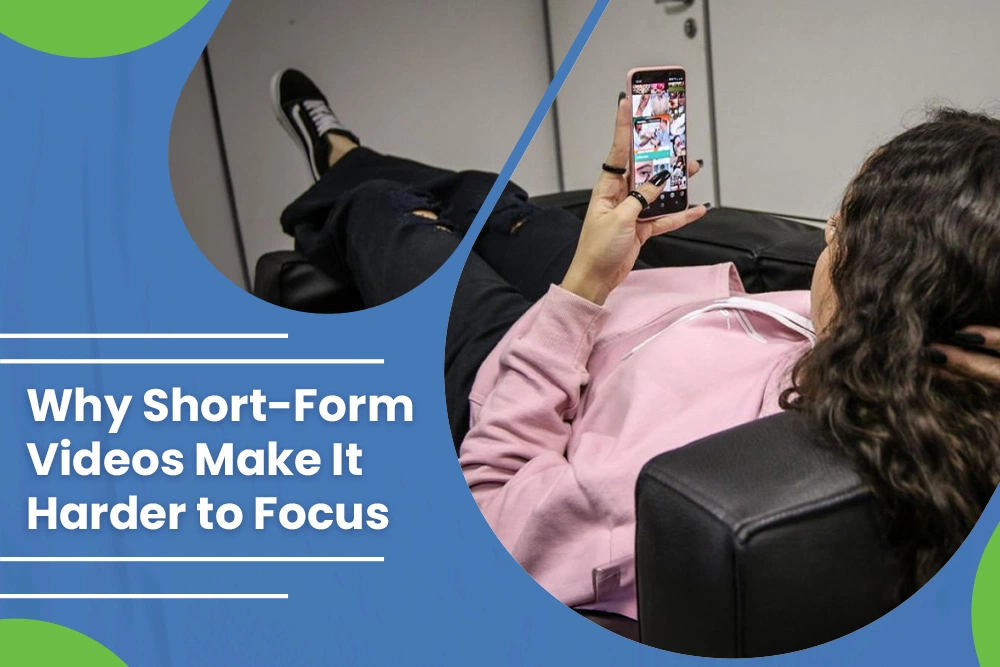
You open your phone to reply to one message. That’s usually how it starts.
Then there’s a clip of a dog wearing sunglasses, a celebrity interview chopped into 20 seconds, a “life-changing” morning routine, and someone cleaning a kitchen at double speed. Before you know it, half an hour has quietly disappeared.
It sounds dramatic to blame a few videos for everything. Phones have been distracting people for years. But short clips feel different somehow. Faster. Stickier. Like your brain never really gets a chance to land anywhere.
The conversation around short-form videos and attention span is growing because people are noticing it in ordinary moments. Reading a few pages feels oddly difficult. A meeting drags. A film that used to be relaxing now feels slow after ten minutes.
Maybe that is not only about the videos. But they probably are not helping.
It’s the speed of it, mostly
Short videos are built around quick payoff. Something happens immediately, or you swipe away.
A joke needs to land in seconds. A recipe has to become visible before you lose interest. A creator has to give you a reason to stay before your thumb does what it has learned to do almost automatically.
That constant movement can make normal life feel strangely underpowered.
A book does not jump into its best bit. Most conversations do not start with a shocking confession. Work, especially, often begins with a dull setup: opening documents, finding information, and trying to remember what you were doing yesterday.
This is where short-form videos and attention become a real issue for many people. The brain starts expecting a reward right away. Not after five minutes. Not after effort. Right now.
And when it does not arrive, scrolling is sitting there, ready.
Related : Managing Digital Burnout Without Losing Productivity
Your brain gets used to the next thing
No one clip is necessarily the problem. It is the endless chain.
There is always another one. Better, funnier, stranger, and more useful-looking. Even when the video is boring, you are only a swipe away from something else. That is part of the appeal, obviously. It feels like control.
But maybe it is too much control.
With long-form content, you usually have to stay put for a while. A podcast may take ten minutes to get interesting. A documentary might have slow parts. A novel definitely has slow parts. You wait a bit, and sometimes the waiting becomes part of why it feels satisfying.
Short clips do not ask for that patience.
The link between short-form videos and attention span may be less about people becoming unable to focus and more about focus becoming harder to tolerate. That is a slightly different thing. You can still concentrate when you have to. But you may feel restless the whole time.
Like your mind is checking the door every few seconds.
The swipe is tiny, but it adds up
Swiping is such a small action that it barely registers. That is what makes it easy to keep doing.
You are not making a big decision to stop working or avoid reading. You are just watching one quick clip. Then another. Then maybe one more because the last one was only 14 seconds anyway.
This kind of digital distraction does not always look serious from the outside. Nobody sees a person sitting silently with their phone and thinks, “That seems like a major interruption.” But mentally, it can split the day into lots of little fragments.
A task gets interrupted. You return to it. You forget where you were. You check something else. You return, less interested than before.
That stop-start feeling can be exhausting, even if the videos themselves feel relaxing.
It changes what “boring” feels like
Boredom used to be more common. Waiting for a bus, standing in a queue, sitting through a quiet evening. None of it was exciting, but it gave the mind some space.
Now, every spare second can be filled.
That sounds efficient until you notice that your brain has stopped knowing what to do with silence. A few quiet minutes can feel uncomfortable. You reach for your phone without really deciding to.
This may be one reason short-form content and focus do not always work well together. Deep concentration has a boring beginning. Almost every meaningful task does. Writing, studying, planning, learning a language, and even cooking from scratch. There is often a point where nothing exciting is happening yet.
If you are used to constant novelty, that point feels longer than it really is.
Or maybe it just feels harder to cross.
It is not always mindless stuff
This part gets missed a lot. Short videos are not all silly dance clips or random memes.
Some are educational. Some teach useful skills. Some help people discover news, health information, books, recipes, careers, politics, and all kinds of things. Plenty of people learn something genuinely helpful from a 30-second video.
So the answer is not that all short videos are bad.
Still, useful content can keep you scrolling too. A productivity tip leads to a study hack. That leads to a therapist explaining boundaries. Then someone is talking about how to wake up at 5 a.m. Suddenly, you have consumed hours of advice and done none of the things you meant to do.
That is the odd part. It can feel productive while quietly replacing actual concentration.
The concern around short-form videos and attention span is not really about intelligence. People are not becoming stupid because they enjoy quick entertainment. It is more about mental pacing. The habit of taking in information in tiny, high-speed pieces.
The reward comes too easily
Short-video platforms are very good at finding what holds your interest.
You watch a few clips about fitness, and more appear. You pause on something funny, and the feed becomes funnier. You engage with a sad story, and suddenly there are ten more waiting.
It can feel personal because it is personal, at least in a data-driven way.
That endless reward loop is why some people use the phrase video addiction, though not everyone who scrolls a lot has an addiction in a clinical sense. The word can get thrown around too casually. But the feeling of wanting to stop and not stopping is familiar to many people.
“I’ll just watch for five minutes” turns into an hour.
Then you feel slightly annoyed with yourself. Maybe guilty. Then you scroll again because you do not feel like dealing with the task you avoided.
Not ideal.
Long things start to feel unusually long
A 90-minute film has not changed. A 20-page chapter has not changed. A work presentation has probably always been too long.
What changes is your tolerance for staying with one thing.
You might notice yourself checking your phone during shows you actually like. Or playing a video in the background while working because silence feels too flat. Or reading the same paragraph three times because part of your brain is waiting for a faster form of stimulation.
That can look like a reduced attention span, but real attention is more complicated than that. Sleep, stress, anxiety, workload, mood, and lack of rest can all make it harder to focus too.
Short videos may not be the whole cause. They are just very available. Very easy. Very constant.
And honestly, that makes them hard to ignore.
It can affect work in quiet ways
Most people do not sit at their desk watching clips for eight straight hours. It is usually smaller than that.
A quick scroll before opening the email. Another one during a break. A few videos while waiting for a file to load. Something after lunch because getting back into work feels difficult.
The issue is the mental switch.
Deep work needs a bit of runway. You cannot always go from a loud, fast, emotionally charged video straight into a spreadsheet, report, article, or difficult email and expect your mind to settle immediately.
That is why short-form videos and attention span can matter even for people who do not think they use social media that much. It is not just total screen time. It is when the clips show up, and what they interrupt.
A few minutes before bed can affect sleep. A few minutes before studying can make studying feel slower. A few minutes between tasks can turn into an afternoon that never quite gets going.
The strange pressure to keep up
There is also a social side to it.
Short videos move trends quickly. One day everyone is using the same phrase. The next day there is a new sound, a new “must-know” story, a new health trend, a new skincare product, and a new argument.
You can feel behind if you are not watching.
That pressure makes the relationship between short-form videos and attention span even messier. People are not only scrolling for entertainment. They are scrolling to stay informed, stay connected, find ideas, understand references, and not miss whatever everyone else is discussing.
It is understandable.
But being connected all the time is not the same as being mentally present.
Related blog: Attention Economy How Modern Tech Rewires Brain
You do not have to quit everything
Deleting every app is not realistic for most people. Also, it is probably unnecessary.
The goal might just be to make the habit less automatic.
Maybe do not open a video app before starting work. Maybe keep your phone out of reach when reading. Maybe watch intentionally instead of letting the feed choose the next 200 clips for you.
That sounds obvious, and it is. Obvious things are still hard when your hand reaches for the phone before you have fully noticed what you are doing.
If short-form videos and attention span are becoming a problem for you, start with one awkward little gap in the day. Five minutes without filling it. Waiting for coffee. Sitting on the train. Lying in bed before sleep.
It may feel boring.
That might be the point.
Maybe focus is not gone, just crowded out
People often talk about focus as if it disappears forever once technology gets involved. That is probably too bleak.
Attention can come back. It just needs room.
When you spend time on something slower, the first few minutes may feel uncomfortable. You might feel an urge to check your phone. You might get restless halfway through a page. That does not mean you have failed at focusing.
It means your brain has become used to being pulled in many directions.
The more you practice staying with one thing, even imperfectly, the easier it may start to feel. Not instantly. Probably not neatly. But gradually.
And yes, you can still watch funny clips sometimes. Nobody needs to become a person who only reads long novels by candlelight.
Just notice when the scrolling stops being fun and starts taking over the spaces where your mind used to settle.
Explore Modafinil products in:
Modafinil In UK, Modafinil In Germany, Modafinil In Europe, Modafinil In Australia
FAQs
- Do short-form videos reduce attention span?
It’s tough to concentrate for long periods of time when you’re often watching them between jobs.
2. Are short videos always bad for focus?
Nope. The typical problem is not an occasional video but endless, automatic scrolling.
3. Why do I feel restless when reading now?
Fast, constantly changing content can make slower activities feel less stimulating at first.
4. Can I improve focus without deleting social media?
Yes. Try keeping video apps away from work, study, meals, or the hour before bed.
5. How much short-video scrolling is too much?
If it regularly disrupts sleep, work, study, or mood, it may be worth setting firmer limits.

Leave a Reply