
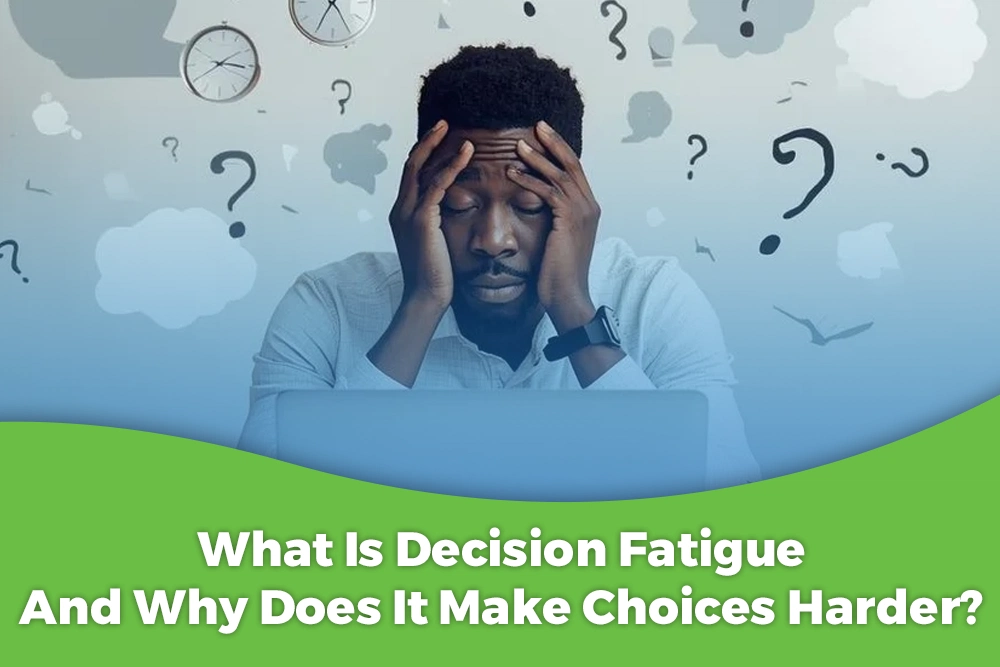
Last Thursday I stood at the open fridge for what felt like ten minutes. I wasn’t even hungry, really. Just stuck. Eggs? Leftover rice? Cereal for dinner, again?
By then I’d already made about a million tiny calls. What to wear, which email to send first, whether to answer that message now or later, and what to say in a meeting I hadn’t prepped for. By seven in the evening, my brain basically said, “No more.”
There’s a name for it, apparently. Decision fatigue. I’ll try to work out what it actually is. I’m no expert, so I’ll probably contradict myself somewhere.
Related: 8 Signs of Decision Fatigue and How To Cope
So what is it, roughly?
The idea is simple enough. The more choices you make, the worse your later ones tend to get. You get impulsive, or you dodge the choice completely, or you just grab whatever’s easiest.
It isn’t the same as being physically tired, although it feels similar. It’s more like a browser with too many tabs open and the fan going loud.
Some researchers call it cognitive depletion, which sounds a bit grand for failing to pick a dinner. You’ll also see decision-making fatigue used, and I think it’s the same thing with a longer name.
Decision fatigue isn’t a medical diagnosis, by the way. Nobody’s going to write it on a sick note.
Where the idea came from
A lot of it goes back to Roy Baumeister and colleagues in the late 1990s. In one experiment, people who’d had to resist fresh cookies gave up sooner on a tricky puzzle afterwards. The theory was that self-control runs on a limited tank, so willpower depletion became the catchy phrase.
Then came the Israeli parole judges study. Judges seemed to approve fewer requests as a session went on, then more after a food break. Everyone loved it. Later, other researchers argued that the order the cases came in probably explained a lot of that. So, shaky.
The wider “ego depletion” idea has also struggled in some big replication attempts. A few found hardly any effect at all.
So I’d be careful here. People clearly do feel this way. I do, and you probably do. But whether decision fatigue works like a battery draining through the day is still being argued about, and I’d rather say that than pretend it’s settled.
What it looks like in real life
At the supermarket checkout, you throw in the chocolate. At 4 pm you agree to a meeting just to end the conversation. You order the same takeaway you always order, because thinking about anything new is too much.
Or you freeze. Decision paralysis is the version where you scroll through streaming options for forty minutes and then rewatch a sitcom you’ve seen five times. That’s me, most Fridays.
Those two look like opposites, but I think they come from the same tired place. Decision fatigue seems to push you one way or the other, rushing or freezing.
Related: Decision Paralysis: The Hidden Cost of Having Too Many Choices
Too many options don’t help
Choice overload is the close cousin. The classic example is the jam study, with 24 flavors on a table versus 6. More people stopped at the big display, but fewer actually bought anything.
Later studies found the effect comes and goes depending on the situation, so I wouldn’t call it a law.
Still, you know the feeling. Forty types of toothpaste. Twelve kinds of milk. Why.
Why would a brain do this?
Cognitive load theory comes out of education research, and it’s a handy way to think about it. Working memory is small. Hold too much, and there’s less room for anything new. Every open question you’re carrying around takes up a bit of that space.
So a day full of little unresolved things, like “Should I reply?”, “What’s for lunch?”, “do I need to book that?”, eats into you even before you’ve made the choices.
If you go hunting for mental fatigue causes, the list is long and a bit boring. Poor sleep, stress, skipping meals, noise, and constant notifications. Decisions are just one item on the pile. That’s partly why I don’t want to blame everything on choices.
Daily decision-making adds up too. You’ll see “35,000 decisions a day” quoted all over the internet, and I can’t find where it actually comes from, so ignore that number. It’s plenty either way.
Related: What Causes Mental Fatigue and How Can You Prevent It?
The stuff that seems to help
Cut the trivial ones. I know people who wear basically the same outfit every day. I’m not that disciplined, but I do rotate about three dinners now, and it’s weirdly calming.
Lay out your clothes the night before. Write tomorrow’s top three tasks at the end of today, so you’re not deciding with a fuzzy head at 9 am.
Make the big decisions early, when you’re fresh. Not at 9 pm when you’re also hungry. Don’t buy a sofa when you’re running on empty. Said by someone who bought a sofa at 9 pm.
Eat something. Hungry plus tired makes for bad choices, and sleep matters more than any trick, sadly.
Limit the options. Give yourself three, not thirty. Set a little deadline, like “ten minutes, then I’ll pick. “Good enough” usually beats “perfect,” although I still fail at that all the time.
The best fix for decision fatigue is pretty dull, really. Fewer decisions, made earlier, with a full stomach.
When it’s maybe not just choices
If you’re wiped out every single day, struggling with even tiny decisions, and it comes with low mood, bad sleep, or trouble concentrating for weeks, mention it to a doctor. In the UK, that’s your GP; in the US, your primary care doctor.
It could be stress or burnout. It could be depression, a thyroid thing, anemia (anemia in the US), or a few other possibilities. A blog can’t tell which. So don’t just put it down to decision fatigue and carry on.
Anyway
I still stand at the fridge sometimes. But I have a rule now. Thursday is pasta. Doesn’t matter what else is going on.
Boring, yes. It works, though, mostly.
Frequently Asked Questions
1. What is decision fatigue?
It’s the drop in the quality of your choices after making lots of them. You tend to rush, avoid, or pick the easy option.
2. Is it a medical condition?
No. It’s a description of how people behave when mentally worn out.
3. Does having fewer options help?
Usually, yes. Three choices are easier to handle than thirty.
4. What time of day is the worst?
Often late afternoon and evening, especially if you’re tired or haven’t eaten.
5. When should I see a doctor for fatigue?
If the exhaustion lasts for weeks, or you have a low mood or poor concentration for weeks.


Leave a Reply