
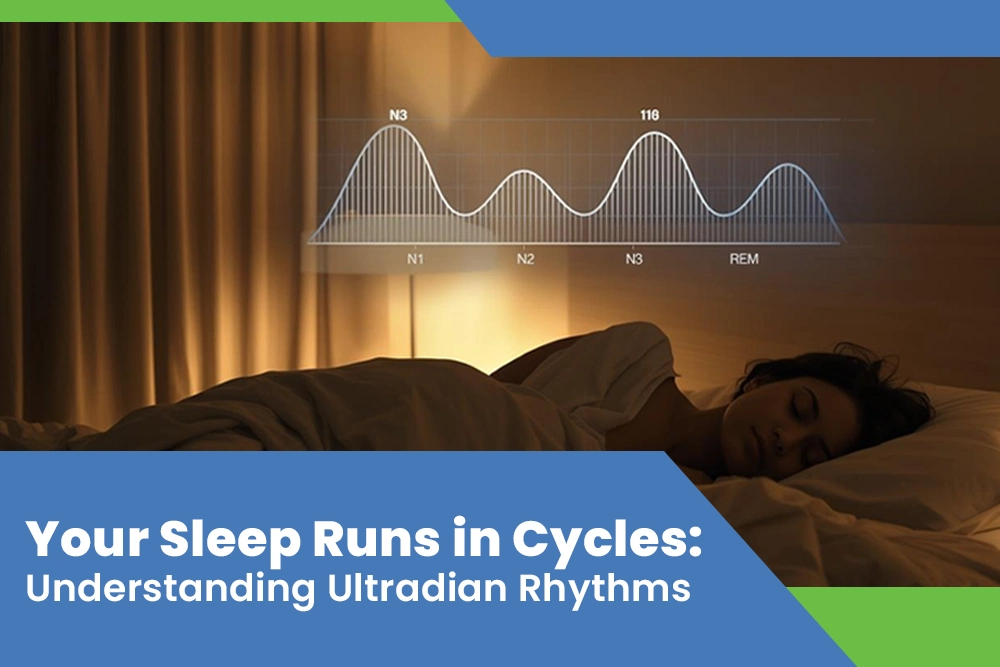
Sleep doesn’t just happen in one long stretch. It moves. It shifts. Most people assume they fall asleep and stay in some kind of steady state until morning, but that’s not really what’s going on underneath. The body runs on shorter internal cycles that repeat throughout the night, and these are known as ultradian rhythms. Unlike the circadian rhythm, which works on a 24-hour loop, ultradian rhythms cycle much faster, usually somewhere between 90 and 120 minutes each time.
It’s a bit odd to think about, honestly. The brain doesn’t treat night as one block of rest. It treats it like a series of laps, each one slightly different from the last, and by morning a person has usually gone through four to six of these loops without ever noticing.
What Is An Ultradian Rhythm?
Ultradian rhythms are biological cycles that repeat more than once within a 24-hour period. Heartbeats, breathing, hormone release, even attention span during the day and many more things run on ultradian timing too, not just sleep. But sleep is where this pattern becomes most noticeable, mostly because it’s structured and repeats in a fairly predictable way.
During sleep specifically, the body moves through a sequence of stages of sleep like light sleep, deeper sleep, and REM sleep and then loops back around to start again. That loop is the ultradian rhythm sleep researchers usually refer to when they talk about sleep architecture. Not the whole night. Just one round of the loop.
Some nights the cycles feel obvious, like you can literally sense yourself surfacing and going back under. Other nights it feels like nothing happened at all, and that’s usually just because the transitions were smoother that time. Doesn’t mean the cycles weren’t there.
How Sleep Cycles Change During The Night?
Early sleep cycles, the ones right after falling asleep, tend to have more deep sleep in them. That heavy, hard-to-wake-up kind of sleep. As the night goes on though, that deep portion shrinks and REM sleep takes up more space instead.
So the first cycle of the night and the last cycle of the night aren’t really doing the same job. First one leans toward physical repair, more or less. Later ones lean more toward REM, which is tied to dreaming and some of the mental processing things like memory, emotional regulation, that whole category. It’s not a clean split though. There’s overlap. Nothing about this is as neat as the sleep charts pretend it is.
This is also why waking up at 3 am and again at 5 am can feel so different. Different stage, different depth, different grogginess level. Some of that is just where in the ultradian cycle a person happens to be sitting when the alarm or the dog, or the neighbor’s car goes off.
How Many Sleep Cycles Occur Each Night?
Most adults go through somewhere around four to six cycles a night, assuming a full night’s sleep, which, let’s be honest, plenty of people aren’t getting anyway. Each cycle runs roughly 90 minutes, sometimes closer to 100 or a little over, and that number isn’t fixed either; it shifts slightly cycle to cycle, and it shifts across people too.
There’s this idea floating around online that everyone needs exactly five cycles, no more no less, like it’s a formula. That’s probably oversimplified. Bodies aren’t that mechanical. Some nights someone might only cycle through four rounds and wake up feeling okay. Other times, six rounds and they still feel like garbage. Cycle count matters, sure, but it’s not the whole story on its own.
REM Sleep Cycle And Why It Keeps Coming Up
REM gets talked about a lot, maybe more than the other stages, probably because it’s linked to dreaming and that’s just more interesting to people than “stage 2 light sleep.” The REM sleep cycle portion tends to get longer as the night progresses. The first cycle might only have a few minutes of REM. By the last cycle or two, it could be stretching out to thirty minutes or more.
That’s part of why dreams right before waking up feel more vivid or more memorable. There’s simply more REM happening by that point, so more material for the brain to work with, so to speak. Earlier dreams exist too, they’re just shorter and usually forgotten fast, which might explain why people rarely recall dreaming from earlier in the night unless something wakes them up mid-cycle.
How Ultradian Rhythms Affect Sleep Quality?
Sleep quality isn’t only about hours logged. Somebody could sleep eight hours and still feel wrecked if the cycles kept getting interrupted, especially if those interruptions happen during deep sleep stages instead of the lighter ones.
Waking naturally between cycles during a lighter stage usually feels smoother. Getting yanked out of deep sleep mid-cycle is rougher, groggier, harder to shake off. That grogginess even has a name, sleep inertia, though that’s kind of a side note.
So when people talk about how sleep cycles affect sleep quality, it’s really about timing more than duration. Two people could both sleep seven hours and have completely different mornings depending on which stage they were in when they woke up.
Sleep Stages Throughout The Night
There isn’t one universal way to number these, but broadly: there’s light sleep, deeper slow-wave sleep, and REM. The sleep stages throughout the night rotate through this sequence over and over, with the ratio shifting as already mentioned-more deep sleep earlier, more REM later.
It’s worth saying this isn’t a perfectly rigid staircase either. The brain sometimes bounces around, dips back into lighter sleep briefly before diving deep again, or has brief semi-awake moments that people don’t even remember the next day. Sleep tracking apps tend to smooth all this into clean graphs, but actual brain activity is messier than that. Worth keeping in mind before trusting a sleep score too much.
Conclusion
Understanding ultradian rhythms isn’t just trivia. It explains why naps timed a certain way work better than others, why waking up mid-cycle feels awful even after “enough” sleep, why some people function fine on slightly less sleep if their cycles are clean and uninterrupted.
It also somewhat explains why alarms set for round numbers like 6 or 7am can feel brutal- there’s no guarantee that number lines up with a natural break between cycles. Some sleep calculators try to estimate this by counting backward in 90-minute blocks from a wake time, and honestly it works okay for some people, less so for others since the exact length varies.
None of this means people need to obsess over tracking every cycle. That can backfire too; overthinking sleep sometimes makes it worse, ironically. But having a rough sense of how ultradian rhythms work, and that sleep isn’t one flat state, at least explains why some nights feel different from others even with the same number of hours logged.
FAQ’s
1. What are ultradian rhythms in simple terms?
Ultradian rhythms are short biological cycles, usually 90 to 120 minutes, that repeat several times a day, including during sleep.
2. How many sleep cycles happen in one night?
Four to six usually depending on total sleep time and individual differences.
3. Is it better to wake up between sleep cycles?
Generally yes; waking during lighter stages feels less groggy than waking mid-deep-sleep.
4. Do ultradian rhythms affect anything besides sleep?
Yes, they also influence things like hormone release, heart rate patterns, and attention cycles during the day.
5. What drink helps you sleep better?
Certain caffeine-free drinks like chamomile tea, warm milk and tart berry juice can help promote relaxation and better sleep.




Leave a Reply